

The Territories That Keep Europe Global : Colonialism, Present Tense
.jpg)
The moment a powerful country talks openly about “claiming” someone else’s land, the word colonialism stops being a history lesson and turns back into a living argument. That is the hook OneWorld uses in its February 6, 2026 inventory of Europe’s overseas territories, beginning with the renewed attention on Greenland after Donald Trump publicly fixated on it. The piece quickly pivots to the deeper question: how can so much non-European land still be politically tethered to Europe, and what do residents actually want from those ties?
Overseas territories are shown as unfinished political projects, held together by law, economics, strategic geography, and, often, a population that has voted to keep the arrangement even while complaining about what the arrangement denies them.
The key distinction that shapes everything: EU “inside” vs “associated”
The European overseas territories are divided into two broad legal categories, because status decides daily life.
Ultraperipheral Regions (UPRs) are fully part of the European Union, so EU rules largely apply and the euro is used. The article notes that this comes with practical perks, such as EU-wide agreements and services, and also with exceptions, for example around taxes because of higher import costs.
Overseas Countries and Territories (OCTs), described in the Dutch text as “Landen en Gebieden Overzee (LGO),” are not part of the EU. Many have self-government, but core powers like defense and foreign affairs often remain with the European state.
That split is the difference between being ruled as an extension of Europe, or being linked to Europe through a relationship that can feel like autonomy on paper and dependency in practice.
But first this...
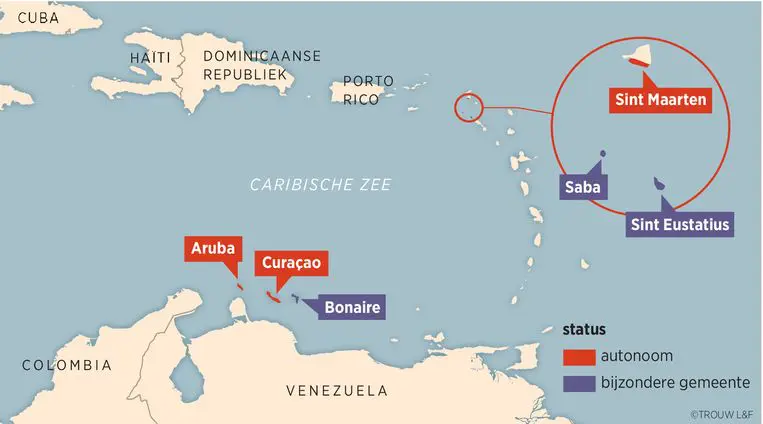
On a map, St. Maarten looks small enough to miss. On the ground, it carries a political fact that is hard to ignore: one island, two European states. Drive a few minutes and you cross from the Dutch side into the French side, not by sea, not by air, but by road. No dramatic border post, no customs line in the way most people imagine borders, just the quiet reminder that Europe’s reach is not confined to Europe.
That split can feel ordinary, even convenient, until you sit with what it represents. An island in the Caribbean, shaped by two legal systems, two administrative cultures, two relationships to the European Union, and two sets of arguments about what residents are owed.
If you want to understand why overseas territories remain one of the most sensitive, persistent pieces of Europe’s political inheritance, you can start here, on a coastline where identity, governance, and power-sharing are not theoretical, they are daily life.
St. Maarten’s split is often described as peaceful, and it is. Yet peaceful does not mean simple. The French side is tied to France, the Dutch side is part of the Kingdom of the Netherlands. That alone creates a layered reality: different rules, different social systems, different political leverage, and different routes to influence.
The border teaches a first lesson about Europe’s overseas territories: “overseas” does not mean outside of power. It means power has been extended, partitioned, negotiated, and normalized.
Status is not a label, it is a life
Across Europe’s overseas holdings, legal status decides what residents can demand and what governments can claim is “not possible.” Some territories sit fully within the EU framework. Others sit alongside it, associated but not included. Some are treated as integral parts of a European state. Others are self-governing, but with key powers retained by the metropole, defense, foreign affairs, and sometimes justice.
Those categories sound like constitutional trivia until you translate them into practical consequences: consumer protections, taxes, cost of living, movement rights, disaster support, public service standards, and representation. In overseas territories, status is a set of limits and entitlements that shows up in your paycheck, your passport experience, and your political voice.
The referenda paradox: “we voted to stay,” and “we’re tired of being second-class”
One of the most revealing threads is how frequently referenda do not deliver the sweeping independence story outsiders expect. The piece cites Francio Guadeloupe explaining that votes often show majorities choosing to keep the relationship as it is, even if the relationship is criticized. In his view, political independence is not automatically seen as a path to a better life, especially in small territories where the economy is narrow and public services can be fragile.
Yet “staying” is not the same as being satisfied. The article argues that many territories increasingly demand equal social rights, like wages, and raise questions about mobility.
On mobility, the piece brings in Guno Jones, who points to a colonial logic that can resurface in modern policy, especially when migration from Caribbean parts of the Kingdom is framed as a problem despite shared nationality. The article notes that proposals have existed to restrict free movement for people from Aruba, Curaçao, and St. Maarten, underscoring how citizenship can be technically equal while politically contested.
In other words, the referenda paradox is this: residents may reject the risks of independence while still insisting that the relationship must stop producing unequal outcomes. “Not sovereign,” still strategic: resources, bases, and the new geopolitics of extraction
Jones argues that political decolonization often failed to resolve the economic inequalities built by colonialism, leaving old dynamics of “extraction” in place through modern capitalism. In this framing, some territories remain positioned as resource producers or strategic assets, even when their political label is no longer “colony.”
The Kingdom of the Netherlands: one family, multiple legal lives
The article's section on Netherlands is especially relevant for Caribbean readers because it describes a constitutional structure that still confuses outsiders: some islands are “countries” within the Kingdom, others are administered as special municipalities.
It explains that after the dissolution of the former Netherlands Antilles in 2010, Aruba, Curaçao, and St. Maarten became autonomous countries within the Kingdom, while Bonaire, Saba, and Sint Eustatius became special municipalities under direct Dutch authority.
The piece contrasts representation, noting that Greenland has seats in the Danish parliament while the Caribbean countries in the Kingdom do not vote in Dutch national elections, and it mentions an advisory trajectory suggesting change could be considered. It tracks referenda and public opinion, including Aruba’s independence referendum history and Curaçao’s 2005 vote to remain in the Kingdom.
It points to St. Maarten’s past referendum numbers and notes plans being discussed for a new referendum. It highlights frustration in the special municipalities, especially Bonaire, where a 2015 referendum rejected the way the “direct bond” with the Netherlands was filled in, and where concerns about poverty and the absence of a defined social minimum are cited.
It recounts how Dutch intervention unfolded in Sint Eustatius, including governance concerns, an appointed commissioner, and a later return toward normal democratic structures. Read together, this section shows why “independence” is not the only axis of debate. Governance, social rights, and democratic voice inside a multi-tier Kingdom can be just as central.
France and the UK
France’s overseas map in the article is large and varied, and that is the point. The piece says France has six territories treated as UPRs and five treated as OCT-type entities, with different internal arrangements.
In French Guiana, Mayotte, French Polynesia, and New Caledonia, the debates look different in detail, but the emotional center often sounds similar: the feeling of being far from decision-making power, the frustration that promises of equality arrive slowly or incompletely, and the suspicion that strategic interests shape what Paris is willing to grant.
The United Kingdom tends to grant local constitutions and parliaments across its overseas territories, with London retaining defense and foreign affairs. The approach is frequently hands-off, but not always. When corruption, governance failures, or crisis emerge, the backstop becomes visible, and intervention can be swift.
The UK’s territories also highlight another feature of overseas reality: uneven economies. Some territories are wealthy and finance-oriented, others are disaster-prone and dependent. This unequal landscape shapes politics, because autonomy feels different when your tax base is broad versus when you are one hurricane away from a fiscal emergency.
What the inventory ultimately exposes
The power of the article is not in listing territories, although the list is extensive and useful. Its real argument is structural: empire did not always end, sometimes it changed clothing.
It shows how sovereignty can be partial, how economic dependence can outlast constitutional change, and how strategic value can keep a relationship “necessary” from a European capital’s perspective. At the same time, it refuses the lazy assumption that residents are simply waiting to break away. The repeated referenda outcomes, and the focus on social rights, underline a more pragmatic demand: if the relationship continues, then residents want it to stop reproducing disadvantage.
St. Maarten is not only a split island. It is a mirror.
It reflects how Europe’s legal systems still shape Caribbean life, and how questions of equality do not vanish just because the relationship has been renamed. It also reflects something else that is easy to overlook: residents are not simply waiting for someone else’s conclusion. They are constantly negotiating their own, sometimes choosing stability over rupture, then demanding respect within stability.
That is the unfinished story of Europe’s overseas territories. Empire did not always end. In many places it became paperwork, policy, funding formulas, and strategic language. And on islands like St. Maarten, you can cross a border in minutes and feel, in the smallest details, how history continues to organize the present.
The uncomfortable closing question that lingers after reading is not only “Why does Europe still have overseas territories?” It is this: what would it mean for Europe to treat those territories as political communities with equal dignity, rather than as strategic spaces that are managed, subsidized, and occasionally listened to?
𝘚𝘰𝘶𝘳𝘤𝘦: “𝘞𝘢𝘢𝘳𝘰𝘮 𝘩𝘦𝘦𝘧𝘵 𝘌𝘶𝘳𝘰𝘱𝘢 𝘯𝘰𝘨 𝘴𝘵𝘦𝘦𝘥𝘴 𝘻𝘰𝘷𝘦𝘦𝘭 𝘰𝘷𝘦𝘳𝘻𝘦𝘦𝘴𝘦 𝘨𝘦𝘣𝘪𝘦𝘥𝘦𝘯?”, 𝘣𝘺 𝘊𝘢𝘳𝘭𝘪𝘫𝘯 𝘛𝘦𝘦𝘷𝘦𝘯 𝘢𝘯𝘥 𝘔𝘢𝘳𝘵𝘦 𝘏𝘰𝘰𝘨𝘦𝘯𝘣𝘰𝘰𝘮, 𝘱𝘶𝘣𝘭𝘪𝘴𝘩𝘦𝘥 𝘍𝘦𝘣𝘳𝘶𝘢𝘳𝘺 6, 2026.
https://www.oneworld.nl/mensenrechten/europese-overzeese-gebieden/