

Native Nations to Parliament: Regulation, not prohibition, is the way forward on cannabis
.jpg)
GREAT BAY--Representatives of Native Nations St. Maarten on Friday used a presentation to Parliament to point out that cannabis regulation is no longer a theoretical discussion for the country, but a practical decision about whether an existing market will remain underground or be brought under control.
In a detailed presentation titled “Cannabis Regulation Framework for Sint Maarten”, the group told lawmakers that cannabis is already accessible throughout the island and that the central policy question is not whether it exists, but whether it will continue to operate illegally and without oversight or be regulated, taxed, and controlled by government.
That framing formed the backbone of the presentation. Native Nations presented regulation as a public health, public safety, and economic necessity, arguing that prohibition leaves the market in the hands of the underground economy while a legal framework would allow government to impose standards, collect revenue, and direct resources toward national priorities. The proposal outlined by the group goes beyond medicinal use and contemplates a broad framework covering medicinal, religious, scientific, adult-use, and industrial cannabis.
The presenters repeatedly stressed that their case is rooted in a wider international shift. Their slides pointed to what they described as a growing global consensus that regulated cannabis markets produce better public health outcomes than prohibition, citing developments in countries such as Canada, Uruguay, Germany, South Africa, Malta, and parts of the United States, as well as ongoing reform efforts and pilot models in the Caribbean. The presentation also highlighted regional developments in Anguilla, Antigua and Barbuda, Barbados, Jamaica, St. Kitts and Nevis, St. Vincent and the Grenadines, Aruba, and the Netherlands, placing St. Maarten within what the group portrayed as an unmistakable policy trend rather than an isolated debate.
In making that argument, Native Nations sought to reassure Parliament that regulation should not be viewed as a reckless leap, but as a controlled policy response to a reality that already exists. The group argued that governments around the world are increasingly moving away from blanket prohibition and toward systems that impose licensing, health safeguards, tracking, packaging rules, and financial oversight. In the St. Maarten context, they said, the choice is whether the island continues to forfeit revenue and control while the market remains informal, or whether it builds a legal structure capable of policing quality, limiting access, and capturing economic value.
A major portion of the presentation focused on the health and therapeutic case for cannabis reform. Native Nations told Parliament there is a wide medical and scientific knowledge base showing therapeutic utility in areas such as chronic pain, inflammation, PTSD, anxiety, sleep disorders, and some neurological conditions. At the same time, the group did not entirely ignore risks. Its presentation acknowledged potential psychological harms, especially in cases involving high-THC products, heavy use, or individuals already vulnerable to psychosis or other mental health issues. But here too the group’s message was that regulation, not prohibition, offers the better safeguard. According to the presenters, a legal framework would make it possible to set THC limits, require product standards, enforce child-resistant packaging, mandate warning labels, and encourage public education and medical guidance.
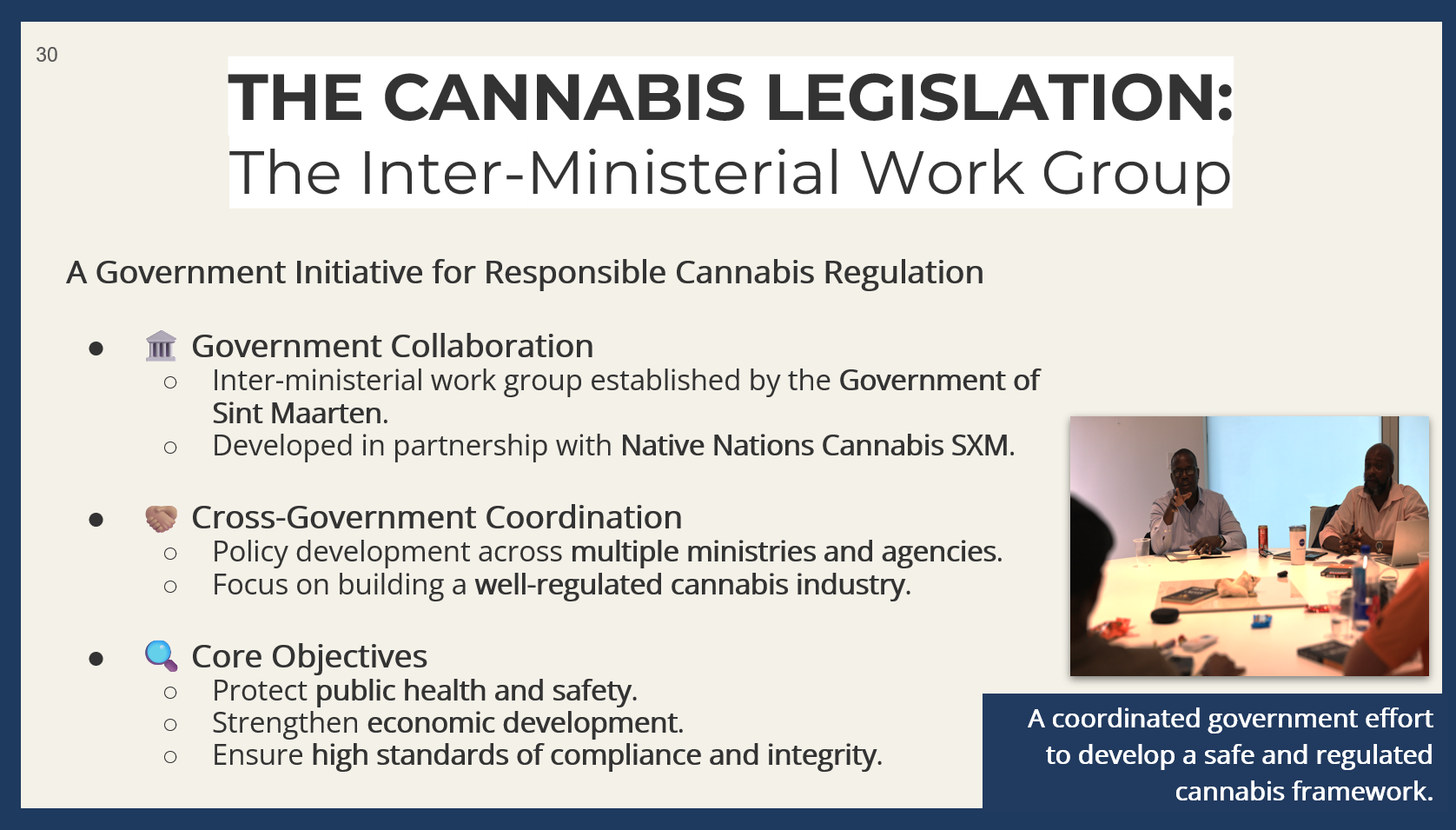
That public health emphasis was tied to the proposed creation of an independent Cannabis Oversight Commission, which Native Nations described as essential to the integrity of the system. In the presentation, the commission was positioned as the body that would oversee compliance, licensing, auditing, banking coordination, and public health integration. The group also emphasized the need for seed-to-sale tracking, using digital monitoring systems and unique identifiers to follow plants and products from cultivation through harvest, distribution, storage, retail sale, or export. In the presenters’ view, this level of traceability is what would separate a legal market from a chaotic one and provide the transparency needed for both regulators and financial institutions.
Economic arguments were among the most ambitious parts of the presentation. Native Nations told Parliament that a regulated cannabis industry could become a major new pillar of the economy, projecting a first-year industry size of $209 million, or roughly 14 percent of St. Maarten’s GDP, along with an estimated $25 million in government revenue in the first year and $149 million over five years. Elsewhere in the presentation, the group projected $500 million in revenue between 2026 and 2030 and an estimated $1.05 billion contribution to the economy over five years, driven by local demand, tourism purchases, and agricultural production. The slides also projected 400 or more direct jobs, an average salary of more than $52,000 for the direct workforce, at least 47 business licenses, and increased tourist spending tied to legalization. These figures were presented as evidence that regulation could diversify the economy, broaden the tax base, and help reduce the national deficit.
Tourism featured heavily in that economic case. Native Nations cited survey data suggesting strong tourist support for legalization, including a Soul Beach survey in which, according to the presentation, three out of four respondents supported legalization and 42 percent said legal cannabis would increase their likelihood of returning to St. Maarten. The presentation also cited a public opinion survey attributed to The People’s Tribune, showing strong support for medicinal legalization, majority support for recreational legalization or legalization under strict conditions, and broad backing for public education campaigns and local participation. For the group, these survey findings were meant to counter the notion that legalization would necessarily damage the island’s image. Instead, the presentation argued that a regulated system could enhance visitor appeal while allowing government to shape the rules, age limits, and public messaging.
Beyond revenue and tourism, the presentation made a deliberate effort to connect cannabis reform to agriculture and food security. Native Nations told Parliament that the framework had been revised in 2024 to include a major farmers program and that the local agricultural component is one of the most important features of the proposal. According to the slides, 19 master farmers and growers have already been engaged, with guaranteed purchase agreements for licensed farmers and a projection of 10 jobs per master farmer, or around 190 direct jobs in the initial phase. The plan envisions a large agricultural cultivation zone subdivided into plots for farmers and agricultural groups, where cannabis would be cultivated alongside traditional food crops using crop rotation practices designed to improve soil health and productivity. The proposal also includes an adjacent farmers market and distribution point for locally grown produce, as well as agricultural tourism opportunities.
The group’s agricultural vision goes further still. The presentation described what it called the Sint Maarten Cultivation Grounds, a self-contained compound that would include a secure cultivation zone, farming land for local growers, a farmers market, a farm-to-table restaurant and wellness space, guided tours, educational exhibits, and on-site retail. One slide even referenced high-level discussions with Snoop Dogg’s management about a recording studio and lounge museum, while another described ongoing negotiations involving the entertainer as a potential brand ambassador for the St. Maarten cannabis market. These elements underscored the extent to which Native Nations is pitching cannabis reform not only as a regulatory issue, but as a wider development strategy combining agriculture, tourism, entertainment, retail, and branding.

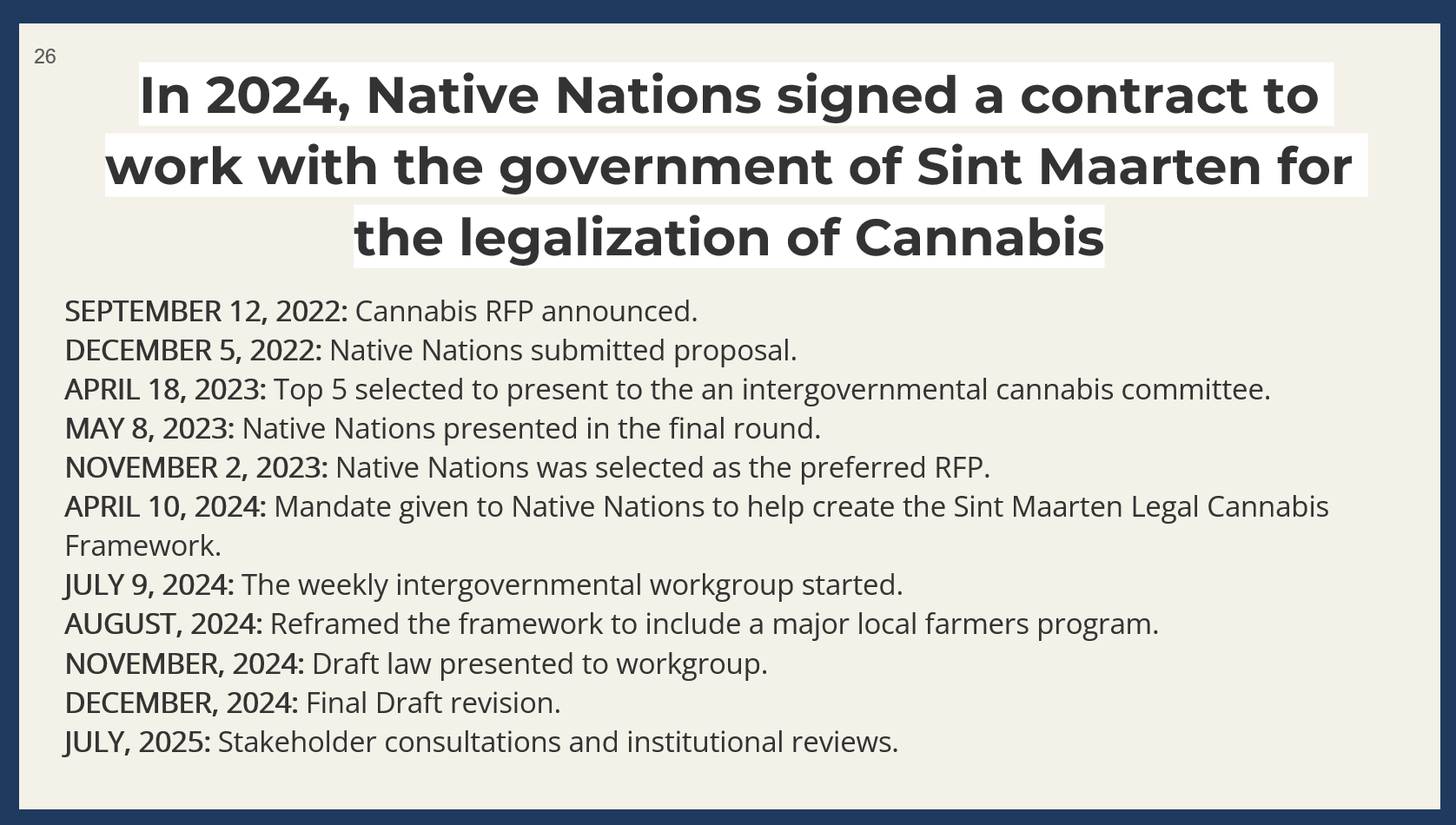
The presenters also spent time defending the legitimacy and depth of the process that produced the framework. Their timeline traced the initiative back to a government RFP announced in September 2022, followed by Native Nations’ proposal submission, finalist presentations, selection as the preferred bidder in November 2023, and a government mandate in April 2024 to help create the legal cannabis framework for St. Maarten. The presentation said a weekly intergovernmental workgroup began meeting in July 2024, that the framework was later reframed to include the farmers program, that draft laws were presented and revised in late 2024, and that stakeholder consultations and institutional reviews continued into 2025. Native Nations told Parliament this process included engagement with ministries, community organizations, financial institutions, mental health groups, farmers, and other stakeholders, as well as public town halls and presentations involving more than 600 community members.
That claim of broad consultation is central to how the group wants the proposal to be understood. The presentation repeatedly described the framework as inclusive, interdisciplinary, and tailored specifically to St. Maarten’s circumstances. Native Nations emphasized that it is a St. Maarten company supported by international expertise and said its advisory and consultant network includes local, regional, and international figures from legal, agricultural, medical, regulatory, and cultural backgrounds. The group’s message to Parliament was that this is not a copied model imported wholesale from elsewhere, but a locally adapted framework informed by outside expertise and island realities.
Another prominent theme in the presentation was the attempt to link cannabis regulation to broader global policy and sustainability goals. Native Nations pointed out that regulation aligns with the United Nations Sustainable Development Goals, supports circular economy principles, and can contribute to objectives such as poverty reduction, food security, decent work, public health, and stronger institutions. The slides also pointed to the World Health Organization’s recognition of cannabis’ therapeutic value and to what the group described as a growing international policy shift toward science-based drug reform. By positioning cannabis regulation within this broader development language, the presentation sought to move the issue out of the narrow frame of vice or morality and into the realm of economic planning, public administration, and sustainable development.