

MPs says real-world answers needed on Nature Policy Plan, enforcement, permits, and zoning
GREAT BAY--The debate on St. Maarten’s updated Nature Policy Plan 2025–2030 on Friday shifted from the Minister of VROMI Patrice Gumbs outlining broad goals, to sharper questions from MPs about what will actually change for residents once and if the document is approved. Across party lines, Members of Parliament asked the minister and his team on practical impact and accountability: enforcement capacity, staffing and continuity, permit decision-making, development pressure in a small island context, the absence of finalized zoning laws, and the credibility of implementation when budgets, inspectors, and penalties are not clearly spelled out.
The central question was not whether biodiversity matters, MPs largely treated that as a given. The tension was whether the plan moves beyond vision language into rules the public can understand, apply, and see enforced, especially in an environment where the same issues keep resurfacing: hillside excavation, mangrove damage, illegal dumping, coastal encroachment, and long-standing claims that permit processes are inconsistent or selectively applied.
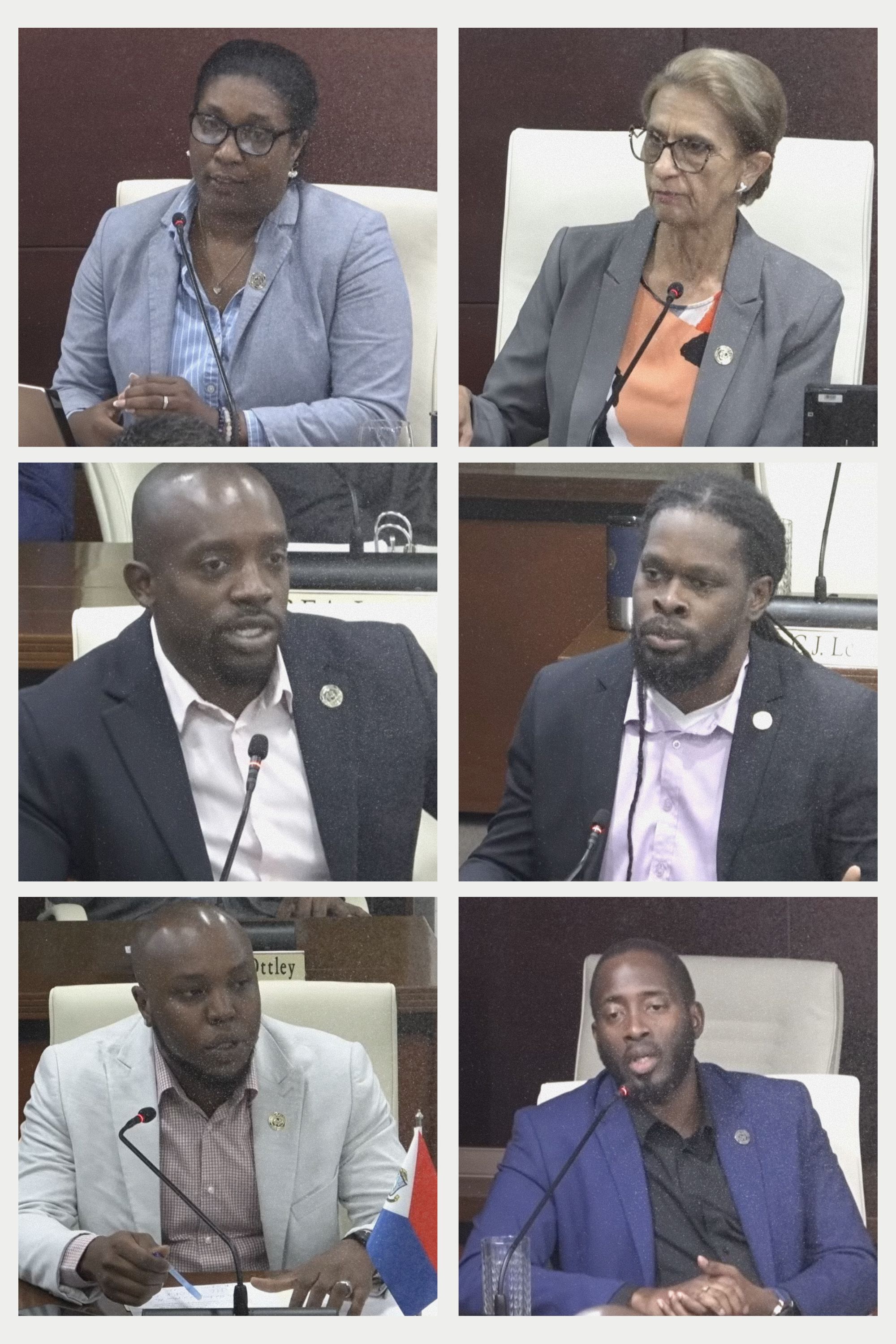
MP Veronica Jansen-Webster went straight to enforcement, questioning what is being done now to protect nature, not what may be done later. She highlighted a detail from the presentation about training at least one VROMI staff member and argued that a single trained person is not enough in a system known for turnover and gaps in continuity. Her point was simple: if enforcement depends on one trained officer, then enforcement collapses the moment that person transfers, resigns, or is reassigned.
Jansen-Webster also asked for clarity on sensitive coastal ecosystems, particularly coral. She raised concerns about whether development activity in the Cay Bay and Indigo Bay area has affected protected coral, including staghorn coral, and whether recent checks have been done to confirm what remains on the seabed. Her questions connected enforcement to tourism, emphasizing that growth in tourism and construction should not come at the expense of fragile marine assets that also underpin the island’s appeal.
MP Egbert Doran focused on clarity and consistency, starting with a question many residents have asked since the previous plan, what is actually different this time. He noted that the framework appears similar to the earlier Nature Policy Plan and asked the minister to explain what core principles were carried forward, and which specific shifts the public should understand. His request was not only for Parliament, but for residents trying to follow a technical policy document.
Continues below...
Doran’s next questions touched on how permits are assessed. He asked what environmental or nature factors the minister personally prioritizes when reviewing permit applications, noting that residents often report receiving different answers depending on who they speak with, or how their request is framed. In a country without finalized zoning laws, discretion can feel like arbitrariness, and arbitrariness quickly turns into suspicion.
He also pressed the minister on how his ministry manages development pressure across districts when land is limited and ecological vulnerability varies by location. He asked how cumulative impact is assessed in areas that have been gradually built up over decades, not by one dramatic project, but by a long chain of decisions that can slowly alter runoff patterns, increase erosion, and weaken coastal and hillside stability.
Doran asked which conservation areas are considered priorities right now, and what makes them priorities. He also raised the question of formal protection, asking whether the ministry is considering additional protected designations similar to the earlier designation of Little Key as a nature park in Simpson Bay Lagoon.
On housing, Doran acknowledged the island’s need, but argued that hillside and runoff vulnerability require clear thresholds. He asked how the ministry determines when a hillside becomes too heavily developed, even where land is privately owned. He also asked whether policy tools such as land swaps or reimbursement mechanisms are being considered when permits are refused due to environmental risk, a question that goes to the heart of fairness when private property rights collide with public interest protection.
He extended the discussion to aesthetics and identity, asking how the ministry considers visual impact, such as construction on high points that can change the island’s character. Finally, he asked which developments or areas are receiving the most attention for inspections and compliance and requested detailed civil works permit statistics, month-by-month requests and approvals over the last year. That request was framed as a transparency measure aimed at addressing repeated public complaints about inconsistency.
MP Darryl York framed his line of questioning around accessibility and tangible outcomes. He argued that the policy language and even the presentation itself are difficult for the average resident to follow, and said he would therefore ask questions in plain terms that people at home could understand. He described letting someone browse the document and hearing the reaction that it felt like “gibberish,” while clarifying he was not dismissing the subject matter, only the communication of it.
York’s key theme was immediacy: what changes next month if the plan is approved. He asked how the plan will reduce tensions between developers and the ministry, and what in the document guarantees better outcomes than the current environment of dispute and mistrust.
He repeatedly returned to one of hs central questions; are there any places where development will be refused, yes or no. If yes, he asked where. If no, he asked what exactly is being protected. He also questioned how headline targets like “30% protected” and “30% restored” translate into specific sites, boundaries, and enforceable decisions.
York said climate resilience is acknowledged in summary language, but not clearly operationalized in a way residents can see. He asked where the plan changes practice in spatial planning, coastal setbacks, watershed restoration, and capital works. He asked what the plan does for flooding, erosion, and storm damage that residents face in every rainy season, and what it changes in preparation for and recovery from hurricanes, even if the plan is not a disaster management document.
Because nature does not follow borders, York asked about concrete cooperation with the French side and what arrangements exist to enforce protection in a coordinated way. His enforcement questions were blunt: what changes tomorrow for people who dump garbage, cut hillsides, or damage mangroves, more fines, more inspections, faster penalties, and if so, how.
He also pressed for evidence of enforcement under existing rules, asking how many environmental fines were issued last year and how many were actually collected. In his framing, policy updates mean little if current enforcement is weak, uneven, or financially toothless.
MP York also questioned governance across agencies. He asked what binding responsibilities other stakeholders carry under the plan, listing entities and ministries that intersect with nature outcomes, such as TEATT, Justice, the Port, the Coast Guard, and Public Health. He noted that the presentation acknowledged weak enforcement historically, yet the policy did not clearly state how many inspectors would be added, when, and with what powers.
He raised a broader political question as well: is the plan driven mainly by international reporting pressure, or by a domestic plan to fix local problems. He asked how the public can tell the difference. He also asked when Environmental Impact Assessments will become truly mandatory, for which types of developments, and from what date.
Finally, York challenged the measurement framework. If baseline data is limited and indicators are difficult, he asked how Parliament can objectively judge success or failure by 2028 or 2030, and what corrective mechanisms exist if annual reviews show targets are being missed.
MP Ardwell Irion’s questions blended enforcement, finance, and land policy, with a repeated concern that the ministry’s current operating reality undermines trust. He raised civil works and excavation permits as a long-running public controversy and said VROMI’s approach “almost looks like favoritism,” particularly when one public development is heavily scrutinized while other activity appears to proceed without the same permit requirements.
Irion also challenged the feasibility of invasive species commitments, arguing that policy must identify priorities and what can realistically be tackled. He used examples to highlight the difference between an invasive list and a practical threat assessment, and argued the plan needs clearer direction about what matters most.
His strongest line of questioning was on financing. He argued that Parliament should not approve a policy that cannot be executed, and said the plan needs clearer costs, priorities, and budget alignment. He asked which aspects are reflected in Budget 2026, which line items, and how much. He suggested an explanatory financial annex that translates policy goals into measurable spending commitments, arguing that “no budget” becomes a circular excuse if costs are never clearly defined.
Irion then expanded into land and zoning consequences, raising questions about recent land acquisition in Belvedere and why it was not clearly reflected in the policy as earlier government-owned parks and sites had been. He asked whether the land is recorded as government-owned, whether parliamentary approval was required, and requested appraisal reports, square meter costs, and documentation clarity, particularly around claims of additional land being acquired “for free.”
On zoning, Irion highlighted that much of the land is privately owned. He argued that if the country designates conservation zones affecting private land, compensation and land acquisition mechanisms must be considered. He asked whether a land acquisition fund exists in the plan or is contemplated in budgeting. He also raised operational costs, noting that acquiring land is one step, maintaining and managing it requires recurring funding.
MP Lyndon Lewis was brief, asking about revenue generation and incentives. Her question implied that policy should also consider sustainable economic pathways linked to nature, not only restrictions and obligations. The subtext was that nature policy may gain broader support if residents can see how conservation can also support livelihoods, resilience, and new economic opportunities.
Chairlady Sarah Wescot-Williams focused on the policy tools that determine whether a plan becomes enforceable practice. Her first line of questioning centered on impact assessments, specifically the difference between case-by-case discretion and a clear framework. She recalled that in earlier discussions it was indicated, possibly by the minister’s predecessor, that an economic impact assessment may be required depending on the ministry’s judgment of whether such an assessment is necessary. Wescot Williams said her understanding is that there is still no established framework that automatically requires economic impact assessments for specific categories of projects. She asked the minister to clarify whether developers face any defined requirements for economic impact assessments, or whether the decision remains discretionary.
She then returned to zoning. Like other MPs, she requested an indication of the country’s overall zoning status, but she added important context from earlier parliamentary discussions. Wescot Williams said MPs had previously been told the ministry was moving away from district-level zoning plans toward a more comprehensive, overall zoning plan, and she asked for an update on where that work stands and what stage it is currently at.
Attached to that, she raised a specific planning concern she said has been asked before: whether there are zoning intentions or proposals for the Mullet Bay and Cupecoy area. She referenced public discussion around the need for a master plan for the Mullet Bay property and noted that she was asking from a broader governmental perspective, not only based on what the property’s managers may prefer.
Finally, Wescot Williams focused on the issue that has repeatedly surfaced during debate on the Nature Policy Plan: implementation clarity. She said that in the presentation she now sees reference to a “Nature Plan,” presented as an annex and described as an implementation plan. She asked if that annex the entire implementation plan tied to the Nature Policy Plan currently under debate, or is it only a foundation that will be followed by a fuller implementation plan later.
She anchored that question to a reporting expectation, noting that, as she understands it, Parliament must receive an implementation report by September 1. She said the presentation includes some budget amounts and references to challenges, but she asked where the implementation plan and the nature plan itself sit in the overall structure. If her reading is incorrect, she asked the minister to clarify exactly what Parliament is looking at, and whether the implementation component presented is complete or still to be developed.