





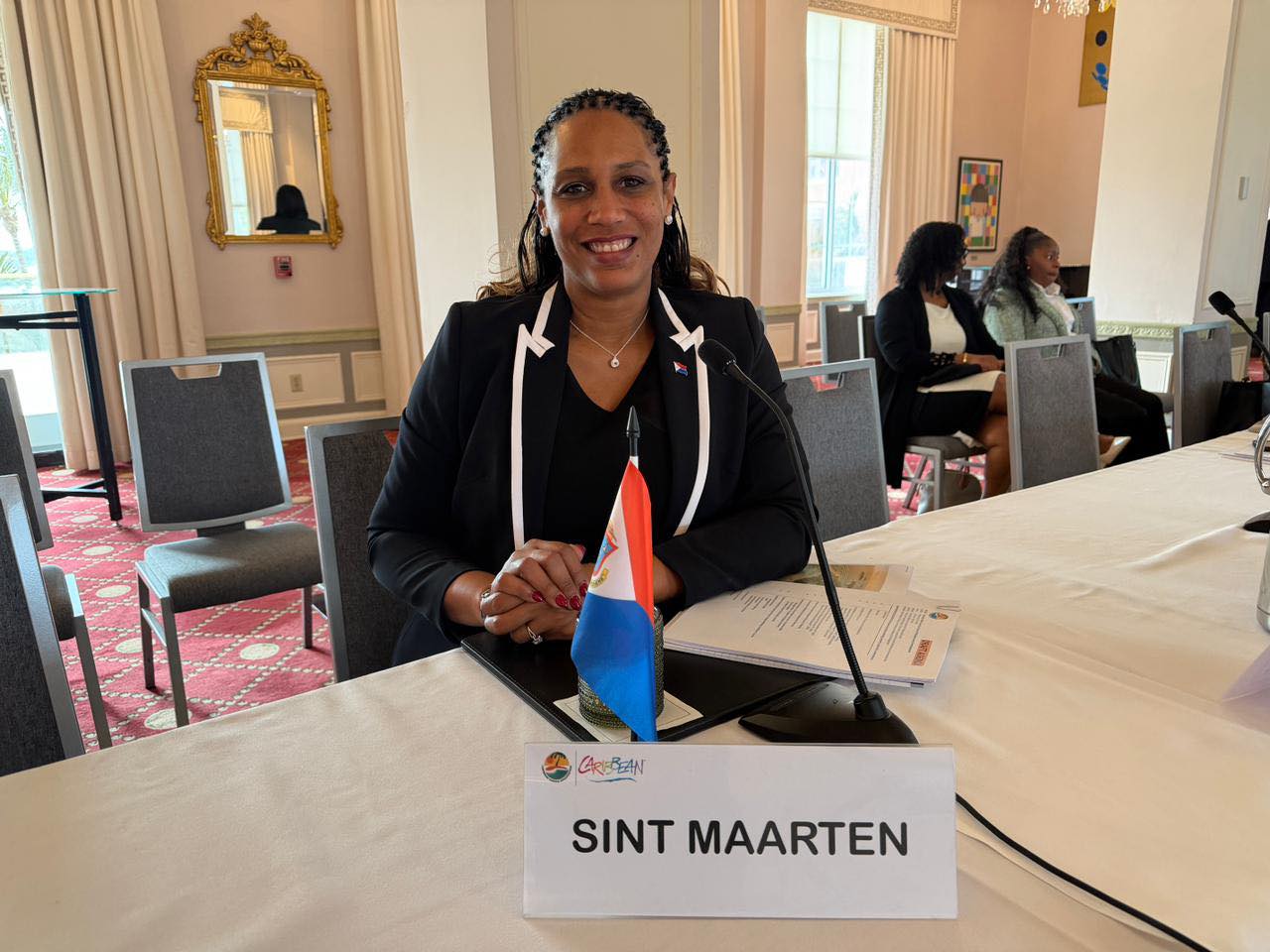
HAMILTON, Bermuda--St. Maarten’s Minister of Tourism, Economic Affairs, Transport and Telecommunication, Grisha Heyliger-Marten, received repeated applause during her remarks at the Caribbean Tourism Organization’s (CTO) airlift conference in Bermuda after directly addressing what many delegates described as the “elephant in the room,” the Caribbean’s persistent lack of intra-regional connectivity and the region’s ongoing difficulty in aligning around a shared, practical approach to air travel.
Speaking during a high-level discussion on regional aviation taxation, fees, and route sustainability, the Minister challenged the mindset that keeps Caribbean destinations operating as isolated markets, emphasizing that the region’s greatest obstacle is not external competition but internal division.
“First and foremost, we must stop seeing each other as competitors. The Caribbean’s greatest competitor is not the United States. Not Europe. Not Canada. It is our own fragmentation.”
The Minister noted that the Caribbean is home to more than 44 million people, yet in many destinations only a small share of air travel comes from within the region. Most passenger traffic is still driven by long-haul markets, which she described as a structural reality shaped by decades of building tourism and aviation systems aimed primarily at visitors from outside the Caribbean. She said marketing budgets, airlift strategies, and revenue models largely reflect that history, while the region’s internal market remains underdeveloped relative to its size and potential.

Minister Heyliger-Marten told delegates she came to Bermuda not only to participate but to learn, to understand what Bermuda does well, to identify shared challenges, and to explore how Caribbean strengths can complement one another rather than compete. She urged delegates to view the region as one diverse tourism space rather than separate products fighting for the same share of demand.
“The Caribbean is not 30 separate tourism products fighting for the same pie. We are one region with extraordinary diversity, and we do not always leverage that enough.”
Addressing taxation and fee regimes, the Minister warned that pricing the Caribbean as disconnected destinations, with varying aviation tax systems, layered fees, and limited coordination, continues to restrict intra-regional movement. She stressed that uniformity does not mean identical taxes. It means coordinated intent, transparency in fee structures, alignment in regional route incentives, data-sharing between airports and tourism authorities, and a shared understanding that stimulating regional demand strengthens route sustainability, particularly during shoulder and low seasons.
She outlined the economic spillover that would result from stronger intra-Caribbean travel, including stronger airline load factors, steadier airport revenues, reduced seasonality pressure on hotels, and wider benefits across the economy, from taxi drivers and restaurants to farmers and creatives. She also emphasized that connectivity is not only economic but cultural, strengthening regional identity by making it easier for Caribbean people to experience each other’s traditions while recognizing their shared heritage and resilience.
The Minister argued that if the Caribbean wants to stimulate intra-regional travel, it must also stimulate Caribbean pride. She pointed to existing cultural platforms that could serve as natural anchors for mobility and collective marketing, including CARIFESTA, the regional Carnival circuit, and Caribbean film festivals. She said the region has the assets, but lacks coordinated promotion.
Her proposal for St. Maarten’s role in that effort includes a stronger focus on promoting St. Maarten within the Caribbean itself.
“My idea for next year is simple: actively promote Sint Maarten within the Caribbean itself. Not just in North America. Not just in Europe or South America. But among our own people.”
“Come get to know us. Taste SXM. Embrace the flavors we have to offer. Let SXM make you feel at home.”
Minister Heyliger-Marten emphasized that achieving this vision requires alignment across institutions, including tourism authorities, national carriers, airports, and governments. She called for coordinated scheduling, fee structures, taxation policy, and wider engagement from finance ministries, civil aviation authorities, immigration, education and culture ministries, and the private sector.
“Connectivity is not just about aircraft movement. It is about mindset movement.”
She said even modest growth in intra-Caribbean travel can improve load factors, stabilize shoulder seasons, and strengthen airline sustainability across multiple islands, describing that as aviation economics rather than rhetoric. She closed her central argument with a call for practical unity that makes movement across the region affordable and realistic for Caribbean people.
“Compete globally. Connect regionally.”
“Because if we continue competing against each other, we shrink. But if we align, we expand our collective market power.”
“When we move together, we grow together.”
Turning to St. Maarten’s airlift strategy, Minister Heyliger-Marten explained that St. Maarten’s strength is not only its one-island, two-nations identity but the intentional way it has been positioned as a regional hub. Through Princess Juliana International Airport (PJIA), she said St. Maarten promotes not only its own destination, but regional connectivity.
“When airlines evaluate Sint Maarten, they are not simply looking at our 8,500 room units. Through our network, they gain access to over 12,000 room units across the northeastern Caribbean cluster. That expanded catchment strengthens demand, improves load factors, and increases route sustainability.”
The Minister said St. Maarten has positioned itself as a gateway to Anguilla, St. Barths, Saba, Statia, and St. Kitts, all reachable in roughly 10 to 15 minutes by air. That proximity supports multi-destination travel, and she said campaigns are being developed to encourage visitors to base in St. Maarten and explore neighboring islands, reinforcing the destination’s hub identity.
“We do not compete with our neighbors. We connect them.”
Highlighting the practical value of this approach for travelers, the Minister said St. Maarten’s model is built around integration, making it possible for visitors to experience the wider region through a single base. She noted that travelers can come to St. Maarten and gain multiple stamps in one week because of how the destination markets and functions as a gateway.
Winair, she said, is central to St. Maarten’s regional strategy, operating services that connect St. Maarten to Saba, Statia, St. Kitts, Nevis, Tortola, Dominica, Guadeloupe, Antigua, Curaçao, Aruba, Bonaire, Haiti, and Trinidad, depending on seasonal demand and charter operations. She noted that the St. Maarten Tourism Bureau and Winair recently strengthened their partnership through joint marketing, coordinated route development, and regional destination promotion, with the stated objective of stimulating intra-Caribbean travel, improving load factors, and reinforcing St. Maarten’s role as a connecting gateway.
The Minister also referenced how air service from the French side complements this ecosystem. She noted that Air Antilles operates out of Grand Case, connecting Saint Martin to Guadeloupe and Martinique, and that those French Caribbean markets generate short-stay traffic to the Dutch side for retail, dining, entertainment, and business. She said two airports on one island allow for diversified flows, with PJIA anchoring long-haul and private aviation while Grand Case strengthens access from French Caribbean markets, and Winair distributing traffic regionally.
She said the incentives that have proven most effective for St. Maarten include joint marketing partnerships, coordinated route support, transparent data-sharing, and long-term airline relationship building. She added that airlines are increasingly evaluating network potential, not only point-to-point demand, and St. Maarten’s integrated model is designed to deliver network depth.
“Our one-island, two-nations model works because it creates integration, not fragmentation.”
“And that commitment to functioning as a true regional hub is why Sint Maarten continues to attract and sustain international air service.”
Join Our Community Today
Subscribe to our mailing list to be the first to receive
breaking news, updates, and more.
