


GREAT BAY--Member of Parliament Omar E.C. Ottley used a January 12, 2026 statement to renew a long-running complaint from public servants and workers in government-owned companies, that many locals feel boxed in by a glass ceiling, unable to move up despite experience, loyalty, and performance.
Ottley, leader of the United People’s Party (UPP), said the concern had become more visible in recent years as public servants voiced “feelings of stagnation, frustration and favoritism,” alongside a perception that their career potential in government and the broader public sector had been capped.
“Too many of our capable locals feel as though they have reached their maximum potential within the government and public sectors,” Ottley said. “It is disheartening to see so many individuals leave what used to be an attractive field of employment. We need to recognize the immense value that our local workforce brings and ensure that they are given the opportunities to thrive.”
GEBE, other government-owned companies, and the question of criteria
Ottley’s statement pointed directly to recent senior appointments at GEBE, the government-owned utility company, as the latest flashpoint. He said those decisions reignited questions about how leadership roles are filled and whether the country is seriously prioritizing local expertise.
He said he had also received complaints from employees at other government-owned companies who believed favoritism was affecting workplace fairness and undermining equal opportunity.
“It is time for a comprehensive review of our hiring and promotion practices,” Ottley said. “We must prioritize innovation and indexation, ensuring that our workforce is equipped with the skills needed to meet today’s demands. Outdated skills can no longer be the norm. It is imperative that we invest in training and development programs that empower our locals to not only meet but exceed the expectations of their roles.”
His message, he said, was ultimately about a public service that looks like the people it serves. “We need a government that reflects the community it serves a government that actively seeks to elevate local talent and ensure that everyone has a fair shot at success.”
What “breaking the glass ceiling” meant in policy terms
After receiving Ottley’s press release for publication, follow-up questions were sent by The Peoples' Tribune to drill down on what “breaking the glass ceiling” would look like in practice, and what government could do quickly.
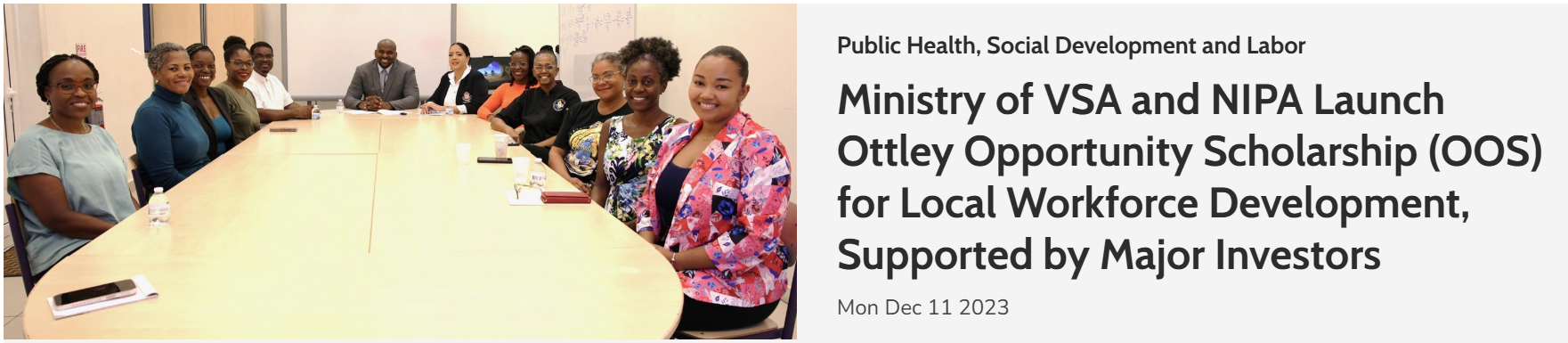
Ottley responded that several policy options were already available and could be implemented promptly, particularly initiatives rooted in programs established during his time as Minister of Public Health, Social Development and Labor (VSA). He pointed to the SOS Policy as one of the most immediate examples of a framework designed to tie investment approvals to local workforce development. Under that policy, investors were mandated to organize job fairs and invest directly in local development through NIPA, a mechanism that, he said, resulted in NIPA receiving approximately USD 300,000 by the end of his term.
He said those revenues were then used to reduce barriers for locals seeking certification and technical training. Through the NIPA Scholarship Program funded by SOS, Ottley said he introduced a scholarship initiative that allowed locals to study at NIPA free of charge, financed by the funds collected through the SOS policy.
Ottley also highlighted what he described as a direct effort to build local capacity in a sector tied to critical infrastructure. He said he activated the DDRP Scholarship Program, which he described as previously dormant, enabling locals to study water production and management. The purpose, he said, was to strengthen local capacity for an eventual transition in operational responsibilities at Seven Seas.
Beyond training pipelines, he pointed to changes aimed at the structure of work itself. Ottley said he initiated amendments to the Civil Code governing labor agreements to modernize them and improve protections for workers, noting that the current Minister of VSA had recently sought advice from the Social Economic Council (SER) on the matter.
He also cited what he described as the largest public-private job fair on record, organized with the business sector and the Department of Labor Affairs, aimed at connecting locals directly with employment opportunities.
Ottley said another tool already existed in current law that could be used more strategically: establishing minimum wages based on sectors and positions, linked to educational levels. He said he had been working on that project, but argued there was limited continuity after his departure.
Regrettably, he added, few of the initiatives he listed were continued or expanded after his term ended, despite what he described as evidence that they worked.
Standards for senior appointments and why locals were leaving
On the question of senior hiring at GEBE and other government-owned companies, Ottley argued the issue went beyond one entity. He said it applied across government-owned companies, government institutions, and also the private sector.
In his view, St. Maarten needed to “broaden our educational and professional horizons” so locals had a real incentive to return home, and he described a pattern in which highly qualified locals left because salary scales were not competitive, locals were labeled “overqualified,” and compensation did not match responsibility or expertise.
To enforce compliance, he said government should establish clear benchmarks for qualifications, experience, and compensation for senior positions, and then lead by example. Where specialized expertise is required, Ottley said salary scales should be aligned with regional and international standards.
“Qualified locals,” foreign recruitment, and an 80/20 model
Ottley also addressed a common justification for international recruitment, that sometimes local capacity is not available. He argued that St. Maarten’s legal framework already contained tools to balance labor market needs and local advancement.
He pointed to a provision in current law allowing the Minister of VSA to determine, per sector, the maximum number or percentage of foreign workers an employer may engage. He contrasted this with what he described as Curaçao’s attempt at a rigid quota system, which he said was later deemed discriminatory.
Ottley argued that St. Maarten could instead implement negotiated, sector-specific agreements developed with the business community. As an example, he said that during his tenure, three major companies voluntarily agreed to an 80/20 ratio, 80% locals and 20% non-locals, through the SOS policy. He described that approach as collaborative, non-discriminatory, and effective.
International recruitment, he added, could still be necessary in specialized cases, but he said it should be temporary, include knowledge transfer, and be paired with mandatory local training initiatives, consistent with the approach outlined in the SOS policy.
Ottley said the comprehensive review he called for should be led by the Department of Labor and the executing agency, Labor Affairs.
He said the review should examine hiring practices, promotion criteria, the use of temporary versus permanent contracts, and the barriers that prevent locals from advancing into senior roles.
Upskilling, modernization, and how success should be measured
Ottley warned that the public sector was falling behind in skills and systems, and in his written responses he tied modernization directly back to investment in human capital.
He said key steps included reinvesting revenues from foreign work permits into local training, expanding initiatives such as SOS and DDRP, and aligning training programs with actual labor market needs. Doing so, he argued, would remove the recurring excuse that “qualified locals do not exist,” because the country would be able to demonstrate that locals were trained and ready.
For measurement, Ottley suggested tracking the number of locals filling skilled and managerial positions, reductions in dependency on foreign labor in key sectors, and successful local management of critical infrastructure. He specifically referenced water production, including future transitions away from operators such as Seven Seas.
Most of the groundwork for these programs, Ottley said, was completed during his two years as Minister. While he said he was pleased to see some expansion today, he maintained that significantly more could have been achieved if continuity had been maintained after his term ended.
Join Our Community Today
Subscribe to our mailing list to be the first to receive
breaking news, updates, and more.