

By The Editor of The Peoples' Tribune
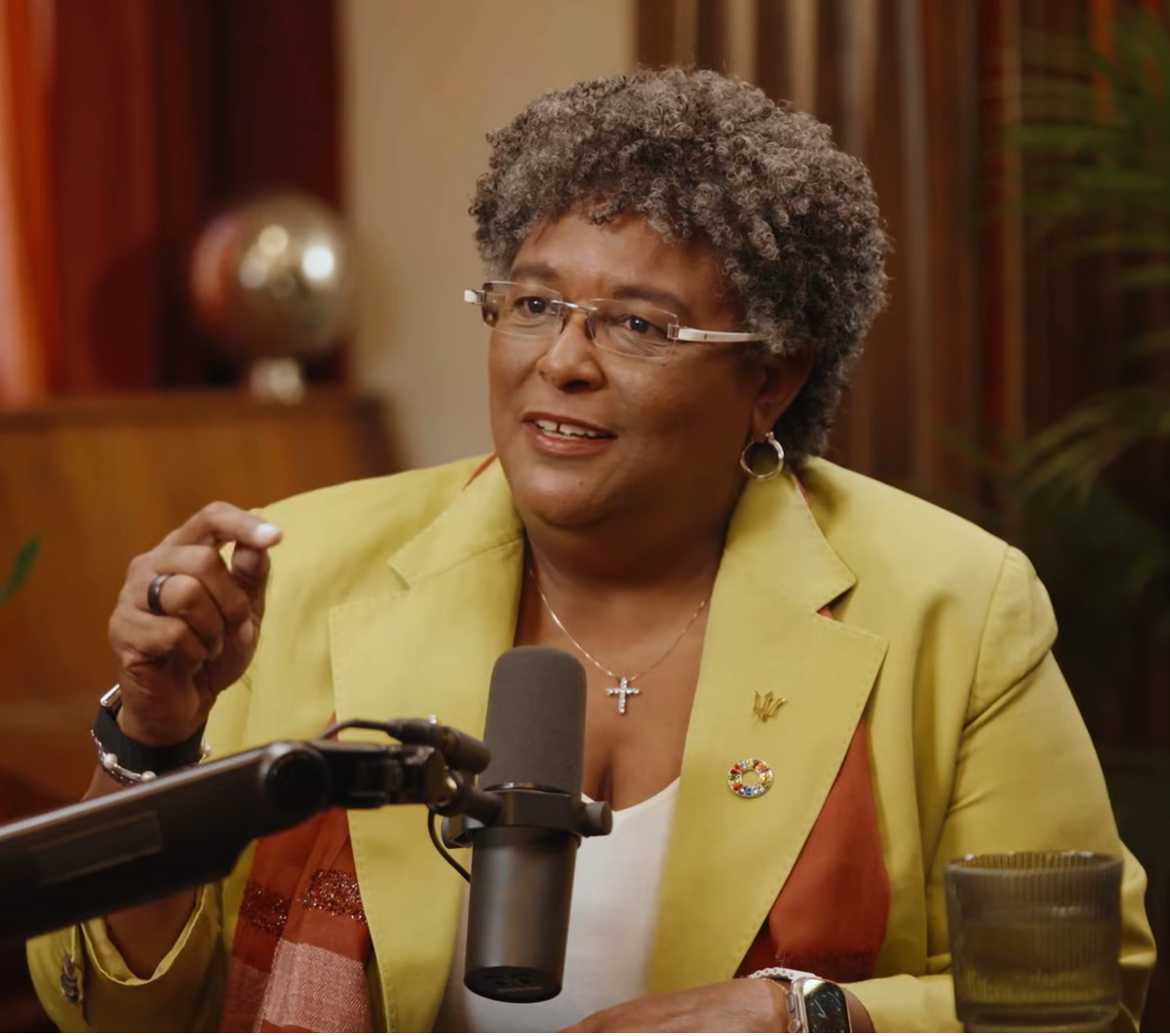
BARBADOS--Trevor Noah on Tuesday opened a bonus episode of his show "What Now? With Trevor Noah" the way he often does when he is at his best, by making space for play without losing sight of what is at stake. Across the table sits Barbados’ Prime Minister, Mia Amor Mottley, and the chemistry is immediate: she leans into humor, he leans into curiosity, and neither lets the laughs dilute the deeper policy discussions.
The conversation moves fast, its touches on Rihanna, the fact that size matters, but not the kind you think, the merits of "road tennis" and more. We will let you the reader experience those parts for yourselves (link is at the end of this article). But although Noah is inherently a comedian by early profession, he has grown into a skilled interviewer and that skill was on display with a Prime Minister who once again proved that she is a force.
Despite playful moments, the interview keeps returning to one through-line: the world has built systems that move money smoothly and people poorly, and the cost shows up everywhere, in shrinking populations, polarized politics, climate risk, and the stubborn unfairness of global finance.
A small country, a big demographic warning
Early on, Noah asks about Barbados’ population, and Mottley answers plainly: “Just under 300,000.” Then she adds the twist, Barbados is not just small, it is getting smaller, “We actually regrettably have declined and we’re right now going through a whole conversation about building back of the population.”
Mottley says part of the decline is migration, but she also credits Barbados’ long-running family planning efforts, “Family planning has been strong in the country from the 1950s.” The striking part is how she grounds the argument in education data. She describes noticing the problem years earlier as Minister of Education and later formalizing the response after winning office in 2018 by creating a National Population Commission. Her evidence is the enrollment pipeline: “I had in those days I had about 4200, 4300 kids every year,” she tells Noah, then contrasts it with the drop by 2018, and the smaller cohorts coming behind, “the ones going in, in infants are like 2200.”
She points to the mismatch between land size and population across CARICOM, arguing that, other than Haiti, “Almost every country in the Caribbean Community is underpopulated.” Her examples are deliberately vivid: the UK compared to Guyana, Israel compared to Belize, the Netherlands compared to Suriname, Singapore’s population growth alongside reclamation, Barbados still “struggling to be at 300,000.”
Noah’s instinct is to ask whether this is mainly a matter of people choosing fewer children as living standards and expectations change, or whether it is the freedom to choose at all. Mottley calls it “a combination,” then pivots to the leadership problem that follows from the diagnosis: once a country concludes it needs more people, what does it do with that truth?
Her answer is both funny and blunt, and it captures the tension between long-term nation-building and immediate labor needs: “I’d like them to, but the reality is that I still need people before they do it the pleasurable way. So while, while they have pleasure in doing it, we’re gonna need that, I still need skills now.”
Managed migration, and the taboo that keeps winning
From there, Noah asks the bigger leadership question he keeps circling, how world leaders should think versus how passive observers tend to think. He frames immigration as the obvious lever many countries tiptoe around. Mottley does not tiptoe. She argues the global conversation about migration is distorted by fear and status, not just economics: “I fear that the conversation about immigration and migration is rooted in racism rather than rooted in the needs of a country.”
She describes a world that has standardized the movement of money, while treating the movement of people as a threat. Her moral frame is sharp, and she ties it to preventable tragedy, “We need a proper deal for migrants,” she says, rejecting a reality where people drown for opportunity while other countries need workers and could provide dignity.
Noah asks whether there is a future where people can work abroad and return home, a system that meets labor demand without turning migration into permanent exile. Mottley says it used to happen more often in structured ways and points to the Canadian farm labor program as a working example, “They go, they come back. This is structured.” She argues technology makes such frameworks easier now, if governments “rolled up our sleeves.”
Then she widens the lens to Africa, describing young men waiting on roads for work while other parts of the world face shortages at “all levels.” Her point is not charity, it is design: a global framework that matches skills and labor demand could make the world “a far better place.”
When Noah asks whether leaders are pushing populations or being pushed by them, Mottley gives a political reality check. Voters matter, leaders can “nudge,” but she says meaningful change will require popular pressure because it alters “power relationships” and the treatment of people across borders.
At one point, she quotes a line she attributes to Ralph Gonsalves of Saint Vincent and the Grenadines: “It’s the Browning of the world.” She argues demographic mixing frightens some societies, and Noah engages without letting it become a single-cause explanation. He suggests resentment can also come from declining living standards and lost security, and Mottley agrees inequity and despair feed anger, which feeds exclusion.
Her governing philosophy here is almost biological. An organism that closes in, she argues, does not thrive. The painful warning is that societies may have to get worse before they get better, before they accept that “the survival of all depends on the well-being and welfare of all,” a lesson she links to COVID.
Climate politics as a language problem, not only a science problem
When the conversation turns to climate, Mottley’s approach is consistent with her earlier migration point. She treats it as an incentives and governance problem, and she searches for what she calls a shared “love language.”
Her example is methane. She says it is “80 times more dangerous than carbon,” and argues that targeted action on methane leaks and flaring could align corporate profit with planetary survival. Fix leaks, capture gas, companies “make more money,” and emissions drop. She makes the claim more urgent by adding what scientists tell her, that getting methane right over the next 15 years could “reverse the temperature by half a degree.”
Noah’s reaction: “How is this missed?” Mottley points to the difficulty of getting people to change without a forcing crisis. She compares climate action to wartime mobilization, noting that when societies decide something is an emergency, impossibility stops being an excuse.
Then she brings it back to finance. She argues climate risk is already rewriting markets through insurance. She describes how insurers retreat from fire zones and flood risk, and warns that what becomes uninsurable becomes “uninvested.” In her telling, this is not theoretical, it is the plumbing of capitalism. Banks require insurance for loans, so when insurance disappears, investment follows it out the door.
Mottley describes Barbados as a leader in issuing commercial paper with “natural disaster clauses,” terms that allow a payment pause after a major hurricane so governments can rebuild without defaulting. She explains the logic in Noah’s language: lenders price risk, so the clause offers certainty and time. She says these clauses can free up “just under 20% of GDP” over two years in a disaster scenario, money that can go into recovery while keeping creditors whole.
Noah connects it to household reality, how one accident or medical bill can wipe people out, and he asks why institutions cannot see that giving people time to become whole is better for everyone. Mottley responds with an image of repair, referencing a poem about reassembling a broken vase and the strength that comes from the care of rebuilding.

The Bridgetown Initiative, and the case against a “close club”
The interview’s most detailed policy thread is the Bridgetown Initiative, Mottley’s push to reform the global financial architecture so vulnerable countries can access affordable capital and meet development and climate goals.
She explains its origin as a convening effort, bringing together people inside and outside institutions, from the UN to NGOs, to frame a reform agenda around “transparency and equity and opportunity.” She ties the urgency to Barbados’ lived reality, hurricane season anxiety and water scarcity, and the whiplash of extreme rainfall, “50% of our 30-year rainfall in the first few months of the year.”
She questions why leadership roles at the IMF and World Bank are effectively reserved for Europe and the United States. She challenges the Security Council’s structure and asks why Africa lacks permanent representation while India has 1.4 billion people without a permanent seat. Then she attacks a technical choice that shapes everything: using historic GDP per capita as the key gatekeeper for access to concessional finance. She calls it like taking someone’s blood pressure two years ago to predict a stroke today.
Noah presses her to name one practice that is “indefensible,” and she offers an example meant to puncture complacency: Greece and Ghana having similar credit ratings at one point, while Greece could borrow far cheaper. She frames it as a system built on “assumptions,” with rules “crafted in the image of a few, not of the many.”
She also takes aim at “middle income” labels that cut countries off from aid and concessional finance despite high vulnerability. When North Atlantic countries treat small states as if they are equal to large nations under one-size-fits-all rules, she argues, they “kill” them economically.
One of the more politically sensitive parts of the interview is her discussion of China’s growing role in the Caribbean. Mottley does not deny China’s presence, she contextualizes it. She recounts how U.S. pressure around ICC exemptions included threats to withdraw military aid, and how a vacuum was filled when China stepped in with training and equipment. Noah responds with his own frustration, wishing Western audiences understood how often Western choices create the downstream problems they later fear.
“We want to be friends of all, satellites of none.” She argues Barbados is not looking to be anyone’s pawn, but it also cannot accept being told not to talk to neighbors who have done it no harm, especially when those neighbors may offer cheaper capital.
Education, attention, and the battle for public reasoning
Mottley worries about children with powerful devices in their hands before maturity catches up. She argues for teaching risk management as children age, and she reframes education as more than facts, since information is now ubiquitous. What matters is values, attitudes, skills, empathy, excellence, and the social and emotional development targets that help a child navigate adolescence.
Noah pushes back on the popular claim that people have no attention span. He points out, correctly, that people can scroll for hours. His diagnosis is not that attention vanished, it is that incentives trained it, a system designed to monetize “the drip drip.” Mottley agrees that discernment and the ability to reason need rebuilding, and she links it to echo chambers and narrowcasting.
Hope and folding chairs
Noah ends with a question about hope, and he frames Barbados as a metaphor for how individuals feel, small, overlooked, underestimated. Mottley answers with a definition, “Hope is human. Without hope, you lose your humanity.” She explains how faith, time, and circumstances can become allies, and she points to how climate disasters have made her message resonate more because people now see echoes of vulnerability in their own lives.
She shares a line she credits to Shirley Chisholm, “If they don’t have a chair at the table for you, bring your folding chair.” In Mottley’s telling, Barbados has been bringing its chair for years.
Noah closes by thanking her for her willingness to break down complex issues, and Mottley returns the gratitude with a reminder of humor’s role in survival, quoting a Trinidadian calypsonian, “You either have to learn to laugh or you go mad and write your epitaph.”
The entire interview can be viewed here: https://www.youtube.com/watch?v=B8AcyFMtDms
Join Our Community Today
Subscribe to our mailing list to be the first to receive
breaking news, updates, and more.