

.jpg)



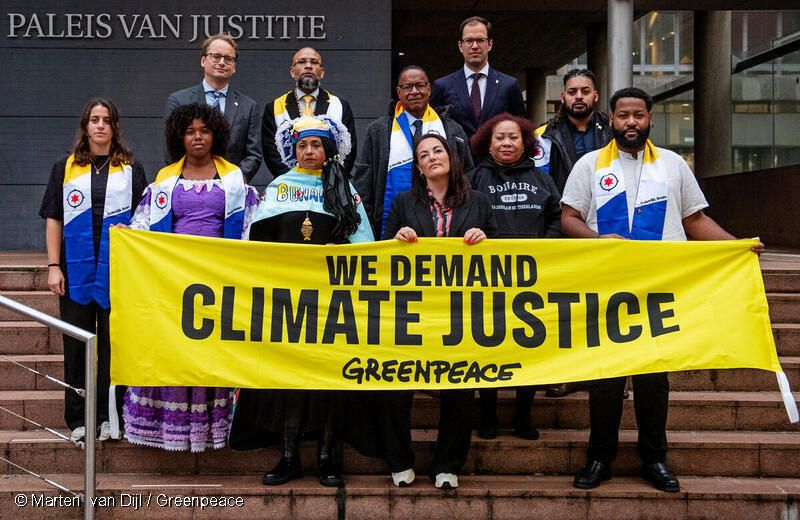
THE HAGUE--The District Court of The Hague has ruled that the Dutch State is not doing enough to protect residents of Bonaire from climate change and its consequences, and that Bonaire residents have been treated differently from residents of the European Netherlands without proper justification. The ruling, delivered in proceedings brought by Greenpeace and Bonaire residents, frames the case as a human rights matter under the European Convention on Human Rights (ECHR) and orders the State to strengthen both mitigation and adaptation measures.
According to the court’s decision, the State must embed binding interim greenhouse-gas reduction targets for the entire economy in national regulations within 18 months, and must also have a detailed plan in place by 2030 to make Bonaire more resilient to climate impacts. The court assessed the State’s climate approach as a whole, including measures to reduce emissions and measures to adapt society and the environment to climate impacts, concluding that the State bears final responsibility for the overall “total picture” of protection.
The ruling recognizes Bonaire’s heightened vulnerability as a small Caribbean island facing risks linked to rising temperatures, sea-level rise, flooding from extreme weather and precipitation, public health impacts, and threats to nature, culture, tourism, and critical infrastructure. The court also found that the Dutch State had insufficiently fulfilled its duty of care toward Bonaire residents, noting that a Bonaire-specific climate approach was not developed in a timely manner despite decades of known vulnerability.
In addressing unequal treatment, the court ruled that Bonaire residents were wrongly treated differently from residents of the European Netherlands and that this amounted to unlawful discrimination in the climate policy context. It concluded that equal treatment does not require identical policies in both places, but does require appropriate policies in both, and found no good reason that measures for Bonaire were taken later and less systematically, even though the impacts are being felt earlier and more severely.
The Climate Case Bonaire was filed in early 2024 by Greenpeace Netherlands and eight Bonaire residents, seeking stronger emissions reductions and a concrete, workable adaptation plan for Bonaire. The District Court previously issued an interim ruling in September 2024 on admissibility, allowing Greenpeace Netherlands to proceed in the collective action. The merits hearing took place in October 2025, with the court announcing it would deliver judgment in January 2026.
The ruling lands at a moment when Caribbean islands are increasingly pressing for clearer, enforceable obligations from metropolitan governments and larger states whose policy choices shape global emissions trajectories. For Bonaire and the wider region, the decision reinforces a principle that climate adaptation is not optional paperwork, it is a governance duty tied to safety, public health, and equal protection under the law.
Join Our Community Today
Subscribe to our mailing list to be the first to receive
breaking news, updates, and more.
