.jpg)



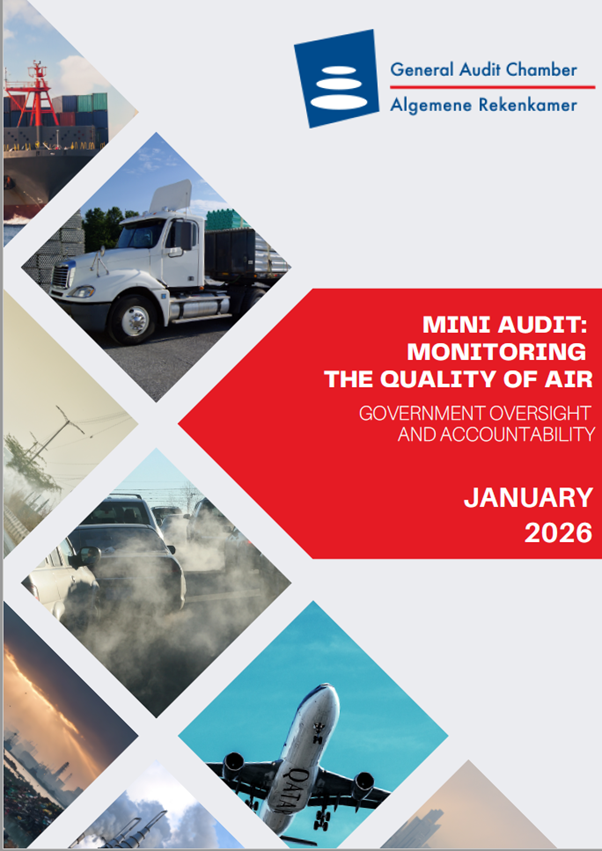
GREAT BAY--The General Audit Chamber has published a mini performance audit on the monitoring of air quality, examining whether government has adequate systems in place to measure, manage, and report on air quality over time. The audit does not assess whether the air on St. Maarten is good or bad, but focuses on governance, monitoring capacity, and policy arrangements.
The Chamber reports that while air quality is referenced in national strategies and policy documents, St. Maarten does not currently have a government-run system that continuously monitors ambient air quality, nor a public reporting platform where residents can access local air quality data or health risk alerts.
According to the report’s summary, efforts to procure air quality monitors began in 2018 under the Trust Fund framework managed by the World Bank, but the process has repeatedly stalled due to delays, leaving the country without reliable, government-generated air quality testing. The report notes that, despite years of discussion and project activity, monitors promised and ordered under recovery-related programming have still not been installed at the time of the audit.
Chairman of the General Audit Chamber, Mr. Alphons Gumbs, stated: “This audit looks at whether government has the tools and systems needed to understand air quality over time. Reliable data supports informed decision-making on public health, environmental policy, urban development, and sustainability.”
Why the Chamber says monitoring matters
The report emphasizes that air quality monitoring supports public health protection and evidence-based policymaking, particularly in areas such as urban planning, waste management, and the transition to cleaner energy. It notes that St. Maarten’s Constitution places a duty on government to protect public health and the environment.
The Chamber highlights the importance of linking environmental indicators with health trends, but reports that St. Maarten currently lacks a structured approach to connect air quality factors with public health data. In particular, the audit states that health departments do not monitor respiratory cases related to air pollution, resulting in limited local data to inform residents and policy frameworks.
The report also points to emerging indicators that strengthen the case for local data. It references unpublished local pediatric research (under editorial review) indicating an increase in pediatric respiratory tract infection admissions in the days following Saharan dust events, with the strongest effect observed three days after exposure, based on a dataset of 596 admissions ages 0 to 17. The audit notes it could not find comparable data on adult impacts.
Past testing, standards, and policy references
The audit notes that one available air quality measurement study was conducted near the Philipsburg landfill in 2019 by the Dutch National Institute for Public Health and the Environment (RIVM). During the two-week sampling period, no or hardly any harmful substances were measured, largely because there were no open fires during testing, limiting conclusions about fire-related exposure. The report states that the RIVM study recommended measurement during actual fire events, and also recommended equipping and training the local fire department to take air samples during fires, with RIVM support.
On standards, the Chamber reports that St. Maarten still relies on air quality standards developed under the former Netherlands Antilles, published in a 2007 Environmental Standards report. It also notes that global air quality guidance was updated in 2021, and that the Ministry indicated the environmental norms applied under the Hindrance Ordinance are under revision, with the update expected to take international guidance into account, including the 2021 WHO air quality guidelines, and alignment with standards used in the Netherlands.
The report reviews policy documents that mention air quality, including the Spatial Development Strategy 2030 and the National Development Vision 2020–2030. It notes that these documents acknowledge risks related to industrial zones, the landfill, and the airport, and reference intentions to strengthen policies and legislation, but the Chamber concludes that these references have not yet translated into a functioning monitoring system, clear implementation steps, or sustained reporting.
Procurement status and intended operation
The audit describes the procurement process for air quality instrumentation as complex and delayed, including issues with bundling meteorological and air quality equipment, retendering after a non-compliant submission, and revisions to specifications due to cost and operational concerns. The report states that procurement originally envisioned 12 stations, later reduced to four due to budget cuts.
The Chamber reports that the monitors are intended to be operated by the Meteorological Department and are expected to support real-time information, including a dashboard and community alert function. The audit notes the department has a website update project underway, which could support real-time monitoring and provide a database once the monitors come online.
Budget and accountability observations
The Chamber finds that the national budget does not include a regular structural line item for air quality monitoring or improvement, and that while funds were made available through external mechanisms, these are not structural. The audit concludes that the absence of routine funding and the lack of a functioning monitoring system signal that air quality has not been treated as an operational priority.
The report was finalized after the Minister was invited to comment on the draft in December 2025. The Chamber notes that a response was received on December 29, 2025, and a further extension was granted until January 21, 2026, but no additional response was received. The Chamber states that executive feedback was considered where relevant, while conclusions remain grounded in the Chamber’s independent assessment of the evidence collected.
Report context
The audit forms part of the General Audit Chamber’s 2025 annual plan, with climate designated as a theme, and positions air quality as an area where governance, public health, and environmental responsibility intersect. The Chamber indicates the mini audit is descriptive and limited in scope, intended to present findings and insights to support policymaking rather than issuing formal recommendations.
Join Our Community Today
Subscribe to our mailing list to be the first to receive
breaking news, updates, and more.