


GREAT BAY--Minister of Education, Culture, Youth and Sport Melissa Gumbs on Monday laid out what she described as a structured path forward to address long-standing supply shortages, sanitation concerns, and operational challenges within the country’s public schools, stressing in Parliament that the focus must now shift from temporary fixes to sustainable solutions.
Appearing before Parliament during a public meeting on the state of operational and sanitary conditions in public schools, Minister Gumbs said her ministry is moving to strengthen internal systems, improve procurement planning, and restore predictability in the delivery of essential school supplies. Among the measures announced were stricter timelines for monthly supply orders, closer coordination with school managers, and plans to reinstate a bulk ordering system to help maintain consistent stock levels across schools.
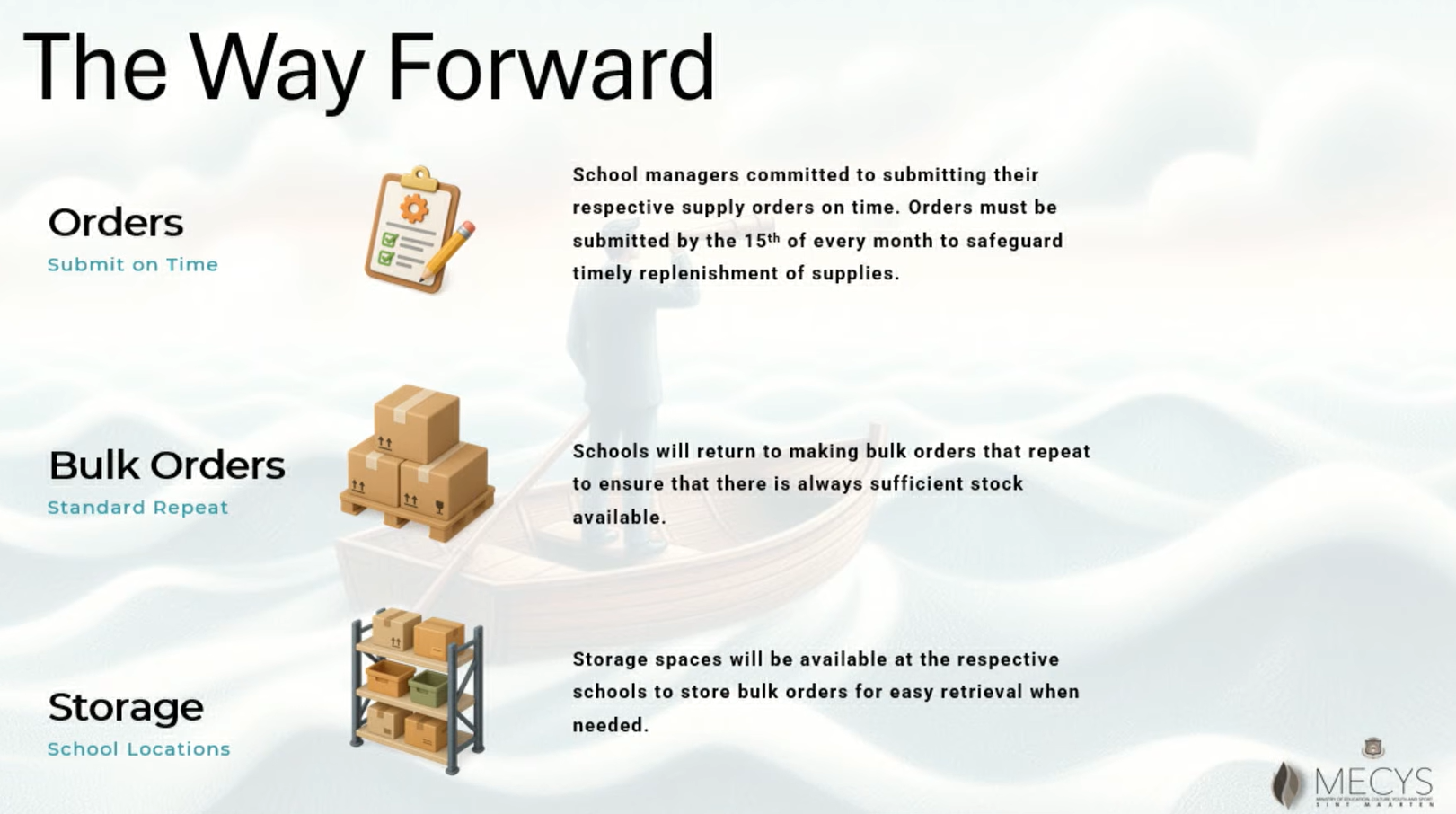
The minister said school managers have already committed, in meetings with the Division of Public Education and the ministry, to submit their supply requests by or before the 15th of each month. This, she explained, is intended to give the Division of Public Education enough time to process orders and coordinate with suppliers before stock is depleted.
Minister Gumbs also announced that the ministry will begin laying the groundwork to return to a bulk supply ordering system that had previously been discontinued after the loss of adequate storage space. She said the renewed system is being designed to ensure that essential supplies remain available on a more consistent basis, particularly at a time when global supply chain disruptions and international instability continue to affect procurement. At the same time, she noted that controls will remain in place to prevent waste, avoid over-allocation, and ensure responsible stock management.
Gumbs told Parliament that her ministry is prioritizing stronger internal processes in order to improve transparency, predictability, and accountability in the management of public school operations. She said the challenges facing schools did not develop overnight and will not be resolved overnight, but emphasized that the ministry is committed to putting systems in place that address them in a structured and sustainable way.
In her presentation, the minister provided broader context for the difficulties affecting public schools, stating that many of the health, sanitation, infrastructure, and procurement issues now being discussed have been ongoing for nearly a decade. She said the country has too often relied on temporary responses instead of building lasting systems capable of preventing recurring problems.
As part of the ministry’s effort to better understand the scope of the situation, Gumbs said assessments were launched in September 2025 in collaboration with the United Nations Office for Project Services to examine infrastructure conditions at several public and subsidized schools. Those assessments identified issues including poor electrical wiring, cracks in older and newer concrete roofs, and other structural deficiencies.
She also noted that in October and November 2025, the Inspector of Public Health was asked to assess concerns related to pigeon infestations at several public schools. According to the minister, those inspections found that some earlier mitigation efforts had failed, with pigeons nesting between spikes that had been installed as a deterrent. At the Marie Genevieve de Weever Primary School, several classrooms were closed after pigeons were found to have infiltrated open ceilings. Rat droppings were also discovered during the inspection, although no active rat infestation was confirmed.
The minister said these examples show that challenges involving school supplies cannot be separated from the wider structural conditions affecting school environments.

On procurement, Gumbs explained that the system depends heavily on school managers submitting orders on time, and on those orders being processed efficiently through the Division of Public Education and the Ministry of Finance. She said delays have often occurred when requests are submitted after the monthly deadline or only once supplies are nearly exhausted, creating pressure on the system and disrupting timely replenishment.
She further disclosed that upon taking office, the ministry encountered a significant number of unpaid invoices connected to supply orders placed before her tenure, some dating back to 2017. In addition, she said an exchange rate discrepancy between government processing and supplier billing has at times complicated payment execution. Despite those constraints, she reported that supplies were delivered to public schools over the last two weeks and that the ministry continues to work with the Ministry of Finance to address the remaining outstanding balances.
During the meeting, Member of Parliament Egbert Doran, one of the MPs who requested the urgent public session, said the concerns raised by parents and teachers over inadequate sanitary items and basic classroom supplies warranted immediate parliamentary attention. He said such shortages affect the proper functioning of schools and the well-being of students and staff.
In closing, Minister Gumbs said the Ministry of ECYS is determined to move away from what she described as “shortcut governance” and toward a model based on planning, maintenance, and long-term accountability.
“What this ministry is committed to doing,” she said, “is ensuring that the systems we put in place moving forward finally address these challenges in a structured and sustainable way so that our schools, our teachers and most importantly, our students are no longer forced to operate within a cycle of temporary fixes.”
The minister said the ministry remains focused on building systems that will better support school operations and create healthier, more reliable learning environments for students and educators across the public school system.
Join Our Community Today
Subscribe to our mailing list to be the first to receive
breaking news, updates, and more.