

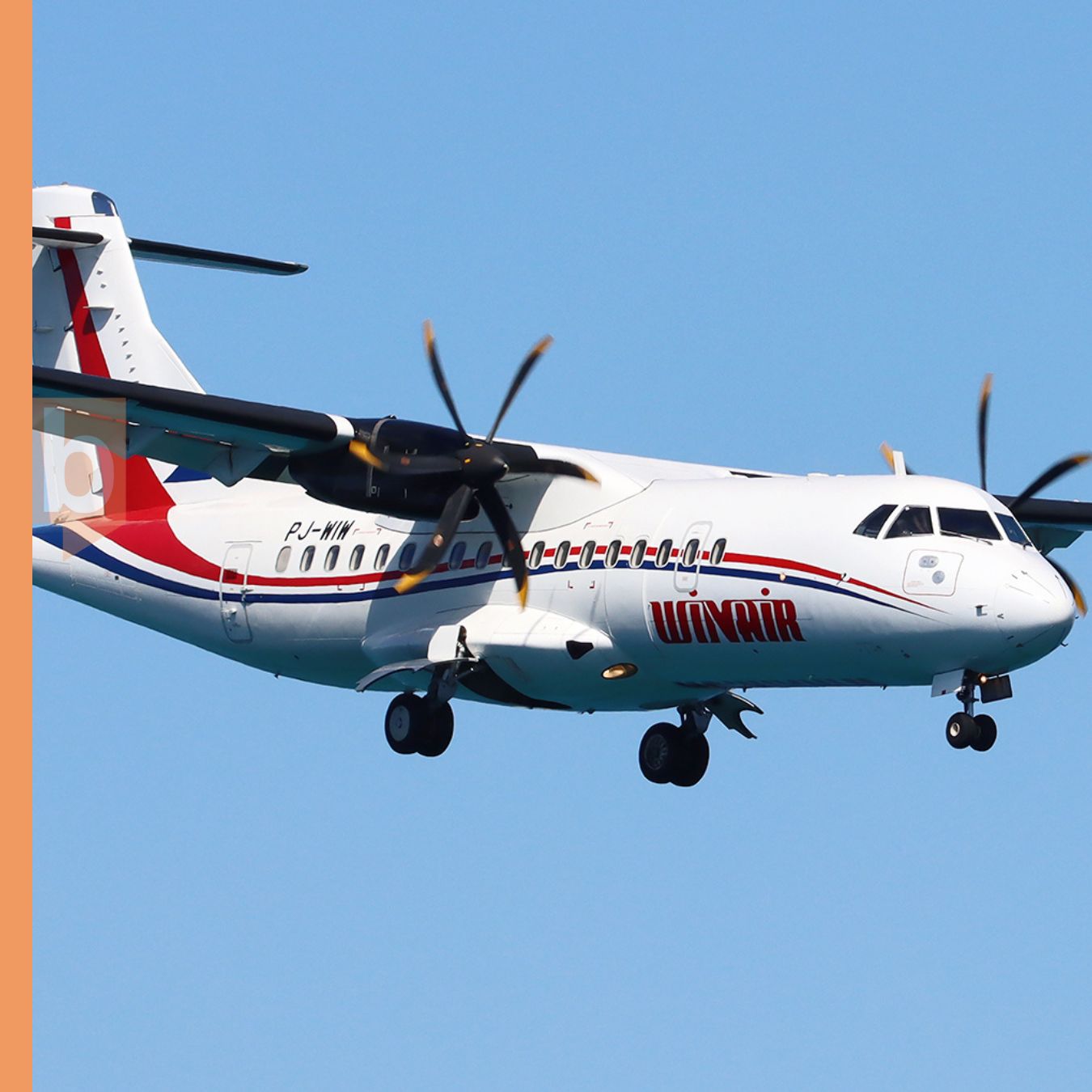



THE HAGUE--If a new amendment to the BES Aviation Act is approved, the Dutch government will gain the power to grant public service concessions on key Caribbean air routes, allowing other airlines to compete with Winair on services linking St. Maarten, Saba and St. Eustatius and to receive subsidies in return for capped fares and guaranteed frequencies.
The bill introduces a legal basis for so-called public service obligations on lightly used but socially crucial routes between the BES islands and other parts of the Kingdom. In such cases the Minister of Infrastructure and Water Management would be able to set minimum standards for continuity, frequency, capacity and ticket prices, then invite any qualified airline from within the Kingdom to operate the route under those conditions. If necessary the minister can restrict a route to a single carrier after a tender and compensate operating losses through a subsidy.
The move follows years of frustration about high ticket prices on the Windward Islands and an evaluation of the Dutch state’s shareholding in Winair. That review concluded that owning shares in the St. Maarten based airline had not delivered the promised affordable connectivity for Saba and St. Eustatius and that the state’s role as shareholder conflicted with the company’s commercial interest in keeping fares high. Alternative ideas such as cutting airport and air traffic control charges or subsidizing tickets were studied, but researchers warned that without binding conditions these measures could simply boost airline profits without guaranteeing lower prices for passengers.
The explanatory memorandum to the bill describes why special intervention is needed in the small Caribbean markets. Operating costs for aircraft, fuel, staff, airport fees and air traffic control must be spread over a limited number of passengers, which drives up what economists call the “generalised travel cost”, a mix of price, travel time, frequency and comfort. Without policy action, the document notes, some routes that are essential for health care, education, work, justice and family ties become commercially unattractive even though island residents depend on them.
Under the proposed rules the minister would first have to analyse the transport needs on a route, including factors such as access to hospitals, schools, courts and jobs, as well as tourism and cultural links. The analysis must also examine whether sea transport offers a realistic alternative. Only if a lack of affordable and reliable air service is clearly demonstrated could a public service obligation be imposed.
Two models are possible. In the first, all airlines that hold the necessary Kingdom traffic rights can choose to operate the route, as long as they meet the prescribed minimum service and price conditions. In the second, the state can limit the route to a single operator selected through a tender, with or without financial compensation. In both cases the intention is to secure a basic level of service at predictable prices, while opening the door for carriers other than Winair to serve the same public interest.
The Inspectorate for the Environment and Transport (ILT) would oversee compliance. The bill extends administrative enforcement powers so the ILT can issue orders subject to penalty payments or impose fines of up to 560,000 US dollars if an airline fails to honor its obligations, for example by cutting back agreed flights or charging higher fares than allowed. Appeals would go to the Court of First Instance for Bonaire, St. Eustatius and Saba.
Because the measure limits the usual liberal aviation regime, the Netherlands must also notify Aruba, Curaçao and St. Maarten under the Multilateral Air Transport Protocol that governs Kingdom air traffic. All airlines that hold protocol traffic rights in the Caribbean region would in principle be eligible to bid for a public service route, which could introduce new competitors on connections that are currently de facto monopolies.
An internet consultation held in mid-2024 drew mostly positive reactions, especially from respondents who stressed how high airfares hinder travel and tourism, particularly on the Windward Islands. Some comments called for treating inter-island flights as public transport and for more sustainable aviation, but others warned that the proposal focuses heavily on the St. Maarten, Saba and St. Eustatius triangle and does not solve all regional access problems. Aruba, Curaçao and St. Maarten were formally consulted as Kingdom partners.
If both houses of the Dutch Parliament approve the amendment, the government aims to bring the new rules into force on 1 October 2026. Only then can the minister take the next step of designating specific routes and launching tenders or setting conditions that would finally allow other airlines to compete with Winair on subsidized, price-controlled services for the BES islands.
Join Our Community Today
Subscribe to our mailing list to be the first to receive
breaking news, updates, and more.
