





ORANJESTAD, Aruba--Dr. Desireé Helder, Director of Directorate of Elderly Affairs, told the Interparliamentary Kingdom Consultation, IPKO, this week that Aruba’s aging trajectory is set to sharply increase the number of people needing care over the next 15 years, raising major questions about staffing, oversight, affordability, and the balance between home care and residential care.

Helder reported that projections based on demographic and health data show the number of care recipients in Aruba rising from 2,825 in 2025 to 5,276 by 2040. Intermediate estimates presented at IPKO place care demand at 3,595 in 2030 and 4,374 in 2035, illustrating a steady climb that more than doubles today’s care load within the planning horizon.
Alongside the rising demand for care, Helder warned of a sharp shift in the support ratio, often described as the “gray burden,” meaning the number of people aged 20–64 available to support older persons. In 2025, she indicated that Aruba had roughly 15 working-age persons supporting one older person, but by 2040 that ratio could fall to about two to one, intensifying pressure on families, communities, and public services.
Helder said the projections were developed with support from a Netherlands-based firm, using Statistics Netherlands data alongside Aruba’s health data and information gathered during a 2020 survey that mapped care needs. The result, she said, is a quantified picture of how many people are expected to require care in 2025 and how that demand expands toward 2040, ranging from less complex care to very complex care.
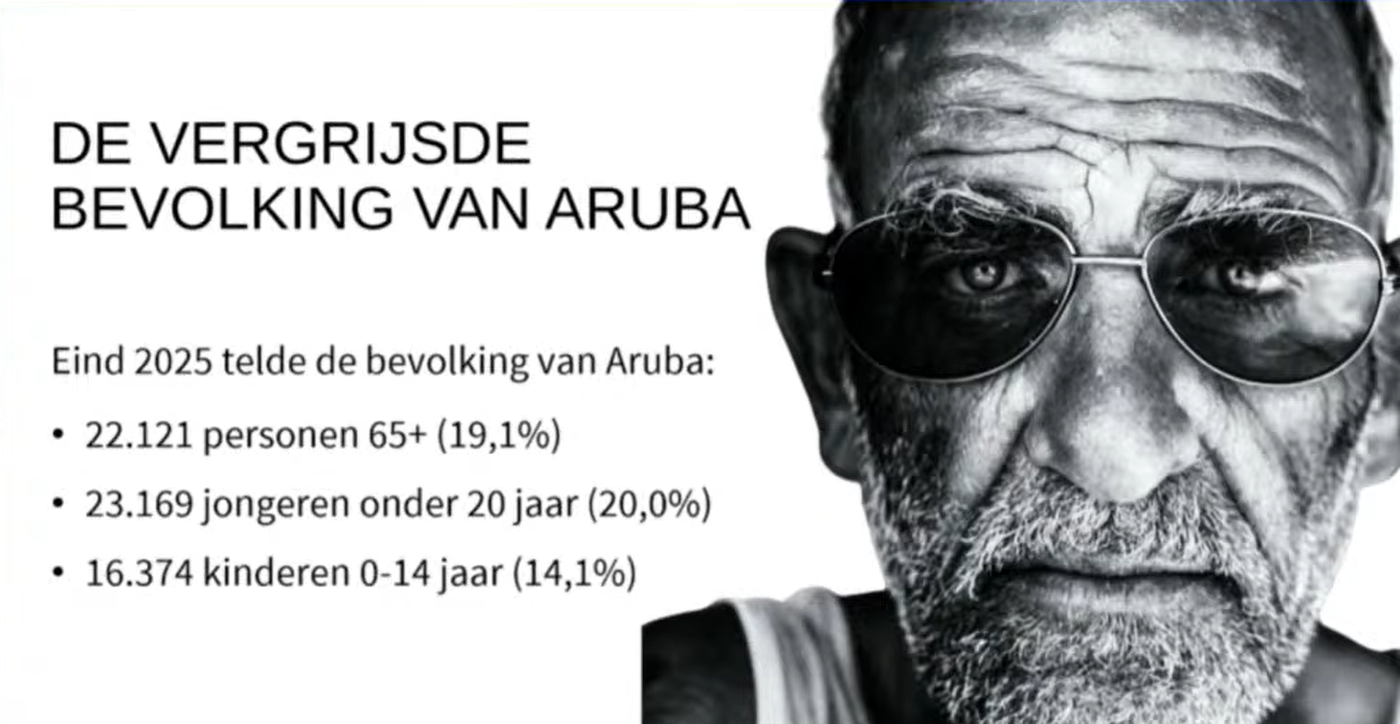
How older persons are cared for today, and where visibility is limited
Helder said Aruba’s care model remains heavily home-based. She explained that many older persons are cared for by family members living in the household, and also by relatives who live elsewhere but still provide support. She noted that “live-in maids” also play a significant role in elder care at home, often recruited from abroad, including from Colombia.
Beyond family and household support, Helder described the role of established home-care organizations providing community nursing and practical services, including assistance with bathing and dressing, wound care, and support related to chronic illness management. She added that as demand increases, Aruba is also seeing a growing number of private care providers, yet the system has limited visibility into parts of that expanding private landscape, which complicates planning and oversight.
Pressure points in home care and residential care
Helder highlighted several bottlenecks in extramural care, including loneliness and isolated living among older persons. She said that challenge can be more acute for older persons not born in Aruba whose family lives abroad, leaving them with less support and, in some cases, incomplete pension coverage.
Additional challenges she flagged included limited transportation options for medical appointments, a lack of assisted living housing, and shortages of well-trained home-care personnel.
In intramural care, Helder described constraints across several fronts: infrastructure limitations, shortages of beds, staffing gaps, and financial barriers, including high costs of nursing home stays. These pressures, she said, drive the need for a coherent strategy that can keep people at home safely for longer while still strengthening residential options for those who need them.

Policy direction presented: “as long as possible at home,” backed by reforms
Helder outlined an integrated policy direction aimed at supporting older persons at home for as long as possible. Elements highlighted included:
- Stimulating and supporting programs focused on participation and activation
- Supporting informal caregivers
- Promoting cooperation and expertise in home care
- Emphasizing “as long as possible at home”
- Implementing new quality requirements for nursing homes
- Restructuring intramural care through a licensing system
She stressed that the approach must be comprehensive to succeed, because aging is not only a health issue, it is also a social, labor, housing, and fiscal issue.
Feedback from delegations, and Helder’s responses
During the discussion, Helder acknowledged concerns raised by the Curaçao delegation that support requires more than training and that keeping older persons at home can shift costs to families that are not always able to carry them. She said Aruba is exploring options, including potential income support for informal caregivers and subsidies for home adaptations, while also considering neighborhood centers and day-care options that can reduce isolation, support families, and encourage intergenerational contact.
Responding to concerns about the high cost of nursing home care and the difficulty of recruiting staff, Helder noted that expanding the workforce is expensive, the work is demanding, and compensation often does not match the burden. She referenced Aruba’s vocational training pathway through EPI, which has worked on shorter training programs to reduce dropout and accelerate entry into the care workforce.
The St. Maarten delegation raised questions about oversight of private nursing homes, whether covenants exist with local partners, and whether there are plans for assisted living. Helder said oversight has largely been reactive due to staffing shortages, meaning inspections follow reports rather than occurring routinely. She stated that covenants with local partners are not yet in place, but that the intention is to establish agreements with nursing homes moving forward. She also said that establishing a Council of Older Persons is under consideration to help assess needs and guide priorities.
Key message for IPKO: match demographic reality with structural action
In response to a request from the Netherlands delegation for a clear takeaway for IPKO on elder care, Helder emphasized the need to address structural issues directly, strengthen cooperation between the commercial sector and government agencies, and use available resources more efficiently.
The Curaçao delegation proposed that the macroeconomic effects of aging, and possible solutions, be placed on a future IPKO agenda for deeper discussion.
Join Our Community Today
Subscribe to our mailing list to be the first to receive
breaking news, updates, and more.
