

.jpg)



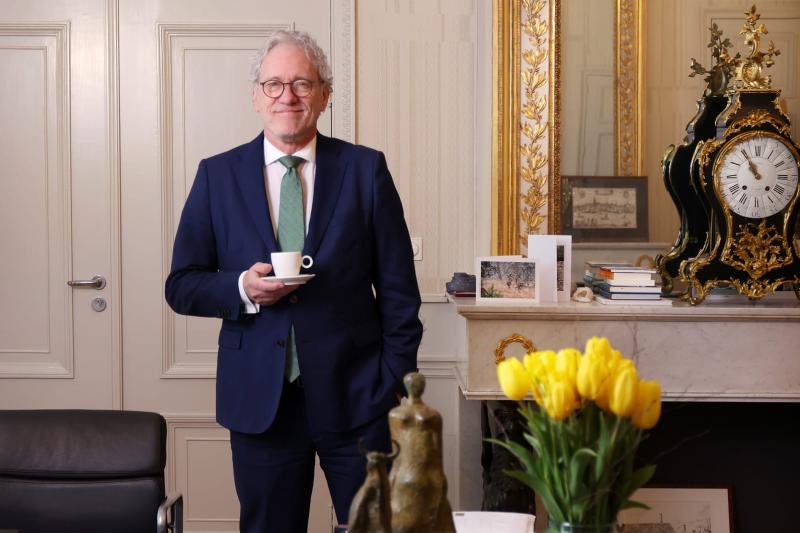
THE HAGUE--Vice President of the Council of State of the Kingdom Thom de Graaf used his Kingdom Day 2025 address o December 15 at The Hague University of Applied Sciences to warn that Kingdom relations are running low on momentum, with political and administrative ties increasingly shaped by mutual distrust and a lack of urgency. While pointing to tangible benefits that citizens experience across the Kingdom, de Graaf argued that better outcomes on poverty, education, and safety will require governments to cooperate more intensively, share knowledge across jurisdictional lines, and invest earlier, rather than waiting until situations become untenable.
Speaking to a gathering organized with strong student involvement, de Graaf praised the role of The Hague University of Applied Sciences in building practical expertise on Kingdom relations, including through coursework for civil servants and collaboration with Leiden University. He framed the student led energy in the room as a needed counterweight to what he described as a stalled political climate surrounding the Kingdom, noting that the seventieth anniversary of the Charter in 2024 did not deliver the renewed momentum many had hoped for.
Dutch political turnover, weak continuity, and a “wind that died down”
De Graaf linked part of the current stagnation to instability in the Netherlands itself, stressing that the portfolio for Kingdom relations has seen rapid turnover. He said four Dutch office holders have held responsibility for Kingdom relations in the past four years, across three cabinets, and he also described frequent turnover in the House committee as a barrier to consistency and continuity. Against that backdrop, he argued that fresh thinking and a broader base of engaged people, especially younger generations, are essential if the next Dutch cabinet is to place a positive Kingdom agenda back on the table.
Council of State as “honest broker,” and why it is worried
De Graaf emphasized the Council of State’s role as a Kingdom institution, describing it as an “honest broker” able to connect interests across the countries, supported by relationships across the islands and by the presence of three Kingdom councillors of state from Curaçao, Aruba, and St. Maarten. He said the Council’s access to information and on the ground realities also fuels concern, because the Kingdom performs well by regional Caribbean standards, yet remains capable of delivering far better results for citizens.
He returned repeatedly to the everyday issues he believes should drive Kingdom cooperation, including poverty reduction, improving education outcomes, and strengthening safety. He argued that citizens do not benefit from competence battles or political posturing, and that administrations should work together “even if that costs money,” especially when earlier cooperation can prevent later crisis interventions.
A “mixed” Kingdom story: clear advantages, but political distrust dominates
De Graaf outlined what he presented as the practical value of the Kingdom for residents, including a higher standard of living in the Caribbean countries compared with many neighboring states, the shared Kingdom passport, and cooperation in law enforcement and justice. He also referenced common defense responsibilities as a reminder of shared strategic interests during a period of rising geopolitical tension.
Alongside these strengths, de Graaf delivered his sharpest warning on the political climate, stating that Kingdom relations have been governed “to a significant degree” by mutual distrust. He described how Caribbean governments often view the Netherlands as too hard and too authoritarian, with insufficient understanding of local complexity and too little respect for autonomy and the colonial history that shaped it. He also described how political The Hague often points to persistent social problems on the islands, sometimes implying they would be solved if local governments tried harder. In his view, this dynamic locks the Kingdom into friction rather than joint problem solving.
Colonial history, slavery, and the limits of “technical fixes”
De Graaf argued that the imbalance inside the Kingdom is not only structural, it is also historical and societal, pointing directly to the long colonial history and slavery as deeper causes that cannot be removed through a small set of technical measures. He said the “shadows of the past” remain visible in prejudice, discrimination, racism, and unequal starting points, and he positioned recent apologies by the King and then Prime Minister Mark Rutte as part of a changing public mindset about the shared past.
Do not rewrite the Charter, apply it better
A central message of the speech was de Graaf’s rejection of large scale constitutional redesign as the primary solution. While acknowledging that he once supported modernization of the Charter, he said he has become wary of major revisions, partly because unanimity is required and consensus on autonomy versus centralization is not in sight. He argued that the Charter does not need to be changed to enable better cooperation, but it does need to be applied better, with greater willingness to pursue practical collaboration and more equality within the existing rules.
Within that approach, he highlighted two longstanding issues that he said remain unresolved, the democratic deficit and the absence of a workable Kingdom dispute settlement arrangement, describing years of debate without proper resolution. He also pointed to the Charter’s guarantee function as evidence that targeted intervention is possible when situations become untenable, then argued that earlier cross boundary cooperation should be used to prevent reaching that point.
Slow responses to advice, and a call for a Kingdom conference
De Graaf said the Council of State’s unsolicited advisory opinion on the future of Kingdom relations, presented in late October 2024, was received positively in the Caribbean countries, yet he criticized the pace of governmental follow up. He stated that it took a year for all four governments to provide initial separate responses, while it remains unclear whether a joint Kingdom wide response will follow or whether there will be a parliamentary debate. He said that delay signals a lack of urgency.
As a remedy, de Graaf proposed organizing a Kingdom conference in the coming year, described as a roundtable style gathering including government representatives, parliamentarians from all four countries, scientists and advisory councils, and young people tasked with pushing new insights and creative solutions into the system. He framed the idea as a way to reset old structures and contradictions with a “new spirit,” and he tied the ambition to a long horizon, maintaining a Kingdom of four countries through 2054, when the Charter would reach its centenary.
He ended where he began, with the role of youth. His message to students was that their generation is needed not only to inspire leaders, but to pressure them into action, so that the Kingdom’s advantages translate into stronger outcomes and a more equal, cooperative future for citizens across all four countries.
Join Our Community Today
Subscribe to our mailing list to be the first to receive
breaking news, updates, and more.